
Yama: The Lord of Death
Step into the halls of Yama-loka, where the ancient Lord of Death presides over the ultimate court of cosmic justice. This exploration of Hindu cosmology reveals Yama not as a villain, but as the impartial guardian of Dharma who uses the infallible records of Chitragupta to balance the scales of karma. Discover how the terrifying transition through the hell realms serves as a profound spiritual mirror, transforming the end of life into a necessary process of soul purification and accountability.
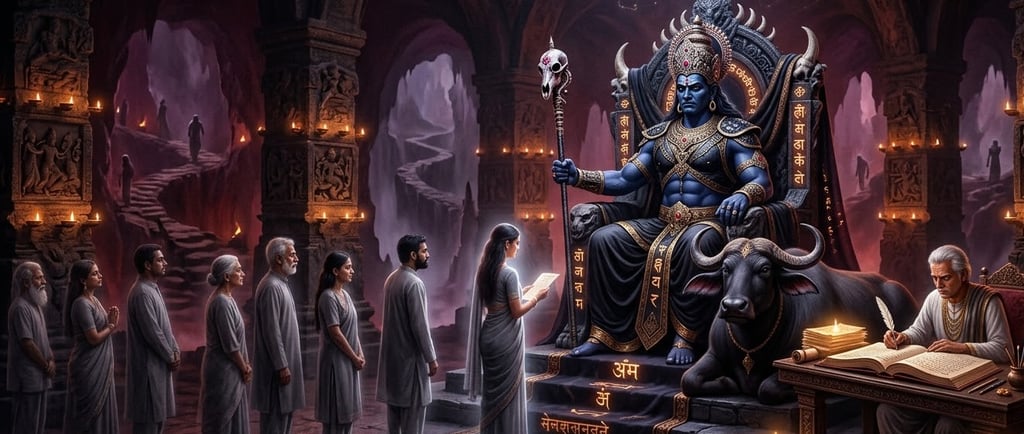
Buddhism adopted many gods from ancient Indian culture (Hinduism). These beings are considered real but still stuck in the cycle of rebirth (Samsara). One of these gods is Yara, the lord of death.
In the extensive and intricate topography of Hindu cosmology, perhaps no figure is as simultaneously feared and revered as Yama, the stern and somber Lord of Death. He is not merely a terrifying specter, but the original progenitor of humanity to enter the divine realms, who ultimately established the paths of mortality. As Yamaraja, the King of Justice (Dharmaraja), he presides with absolute impartiality over the realms of the dead, known as Yama-loka or Naraka (the varied hell realms), where he executes the definitive and unavoidable judgment upon the souls that arrive at his gated threshold. Far from the capricious and malevolent reapers of other mythologies, Yama represents the inexorable cosmic order (Rta), ensuring that the universal law of karma is perfectly balanced and that all actions, both virtuous and wicked, bear their absolute and corresponding fruits. The transition from life to death is not a random cessation but a precisely orchestrated passage over which this primal deity maintains an unwavering and terrifying watch.
Yama’s presence is first established in the earliest layer of Hindu scriptures, the Vedas, where he occupies a distinctly different role than his later, more fearsome iteration in the Puranas. In the Rig Veda, Yama is recognized as the son of the solar deity Vivasvat and Saranyu, and he is acclaimed as the very first mortal to lay down his life. Because he pioneered this inevitable path, he became the King of the Pitris, or the revered ancestors, ruling not a desolate underworld of torment, but a celestial, shadowless realm where the virtuous souls of the departed drink soma and enjoy eternal, light-filled fellowship. In this primal aspect, Yama is viewed with reverence, even affection, as the pathfinder. However, as the theology evolved into the Puranas and the complex doctrine of karma solidified, his role underwent a profound, seismic shift. Yama became the specialized agent responsible for Dharma itself, transforming from the benevolent king of ancestors into the unyielding judge of the sinful. His dominion became Naraka, the labyrinthine structure of multiple distinct hells, designed to hold, punish, and eventually purify those whose heavy burden of karma prevented their direct passage to higher, celestial planes. This evolution marks the complete transformation of the pathfinder into the jailer, the ancestor into the ultimate arbiter of moral debt.
The moment of death triggers the terrifying descent into Yama’s presence, which is an experience of agonizing clarity. As the physical body expires, the atman (soul) is instantly encased in a dense, subtle vehicle known as the yatana-sarira, designed specifically to withstand the grueling torments of the hell realms. This soul is then violently seized by Yama's dreaded emissaries, the Yama-dutas, fearsome, ghastly figures with ropes, clubs, and fangs, who drag the terrified soul across the vast, burning distance toward Yama-loka. This journey itself is described in graphic detail as a nightmare of burning sands, poisonous forests, and biting cold, emphasizing that judgment begins not when one arrives, but when the karmic account is called. The soul’s destination is the formidable palace of Yama, where the Lord of Death waits, seated upon his mighty buffalo mount, radiating an aura of severe authority. It is here, at the threshold of eternal consequence, that the concept of individual agency and ultimate responsibility is perfectly realized. There is no escaping this court, no bribes to offer, and no lawyer to speak, for Yama holds all the cards.
Yama’s method of judgment is nothing short of absolute, leaving no possibility for error or evasion. He does not rely on circumstantial evidence or witness testimony, but rather on the objective, metaphysical records of the universe. This omniscience is realized through his powerful accountant, Chitragupta, whose name significantly translates to "Rich in Secrets" or "The Clandestine Picture." Chitragupta sits beside Yamaraja, holding the colossal tome known as the Agra-Sandhani or the Book of Ultimate Destiny. This book is not a mere list, but a perfect, living, holographic recording of every single thought, intention, word, and deed committed by every living being during their entire earthly existence. When the Yatana-sarira stands shivering before the judgment seat, Yama commands Chitragupta to read the account. This moment is the quintessential definition of Dharma, or Cosmic Justice. Chitragupta opens the massive registry and recites the actions of the soul. No hidden deed remains concealed; no private thought, good or bad, is omitted. The soul stands intellectually and spiritually naked, facing the perfect clarity of its own moral footprint. The absolute inevitability of this judgment forms the crux of the terrifying moral philosophy inherent in Yama’s domain, ensuring that no action, however small, is ever truly lost.
Following the reading of the inescapable scroll, Yamaraja delivers his definitive sentence with immediate and terrifying finality. This sentence is not arbitrary; it is the organic conclusion of the karma revealed by Chitragupta. If the good actions outweigh the evil, the soul is briefly escorted to various heavens (svargas) for reward before reincarnation. However, if the negative karmic balance is insurmountable, the soul is condemned to Naraka, the varied, structured hell realms where specific punishments are meted out to balance specific transgressions. The descriptions of these hells are intended to horrify: Andhatamisra (The Blind Darkness), for those who lie or hoard; Raurava (The Howling Hell), for those who live on violence; Kumbhipaka (Cooked in Pots), for those who harm animals; and Asipatravana (The Forest of Sword Blades), for tyrants. Each realm is tailored to inflict exactly the type of suffering the individual caused to others, ensuring that the soul experiences the precise agony of its own crimes. These punishments are not meant to be eternal; rather, they are purgatorial, serving as the grinding mechanism that burns away the heavy density of the ego and its sinful karmic residue until the soul is purified enough to be re-released into the cycle of Samsara (reincarnation). This cycle underscores that Yama is not an agent of eternal damnation, but rather a vital part of the purifying cosmic furnace.
Yama, despite his horrifying duties, must be understood not as a villain but as an indispensable pillar of the divine hierarchy, often explicitly equated with Dharma itself. He is a Lokapala, a Guardian of the Directions, maintaining cosmic equilibrium. While his aspect is terrifying, it is the terror of truth, of absolute responsibility that most humans frantically avoid in life. In Hindu tradition, remembering Yama an event known as Yama-Chintan is a powerful and crucial spiritual practice. This recollection is not based in fear but is designed to act as a profound motivator. It reminds the seeker that every moment of their life matters, that their actions are recorded, and that the illusion of invincibility is a profound spiritual trap. Yama therefore functions as the ultimate spiritual mirror, forcing humanity to confront the terrifying reality that their character and actions alone are their only final companions. In this light, his severe judgment is not an end, but the absolute and necessary gateway toward the truth, the inevitable step that every soul must eventually take to fully understand the intricate and perfect order of the cosmos. By facing Yama, the soul must, at last, truly face itself.
Sera Jey Wisdom Center
A Gelug Tibetan Buddhist center in Jakarta. Join our weekly prayers every Saturday at 2 PM — everyone is welcome.
Address
Sera Jey Wisdom Center
Ruko Savoy Blok C1 No.31 & 32,
River Garden Jakarta Garden City,
Cakung Timur, Jakarta Timur 13910,
Indonesia
© 2026 Sera Jey Wisdom Center Jakarta. All rights reserved.