Vajrayogini: Represents The Ultimate Realization Of Emptiness And Bliss
Vajrayogini is a fully enlightened female Buddha of the Highest Yoga Tantra, representing the union of infinite bliss and emptiness. Depicted as a vibrant, dancing red figure, she symbolizes the transformation of ordinary passion into spiritual awakening. Her practice is considered a swift, powerful path to Buddhahood, designed to help practitioners cut through ego-delusion and realize their own inherent, awakened nature.
In the rich tapestry of Tibetan Buddhism, few figures are as captivating, profound, and sometimes misunderstood as Vajrayogini.
She is not merely a deity to be worshipped but a complete path to enlightenment, a living embodiment of awakened wisdom, and a fierce expression of compassion. To understand Vajrayogini is to delve into the heart of Tantric practice, where conventional notions of reality are shattered, and the mundane is transformed into the sacred. She represents the ultimate realization of emptiness and bliss, a union that is the hallmark of the highest yoga tantras.
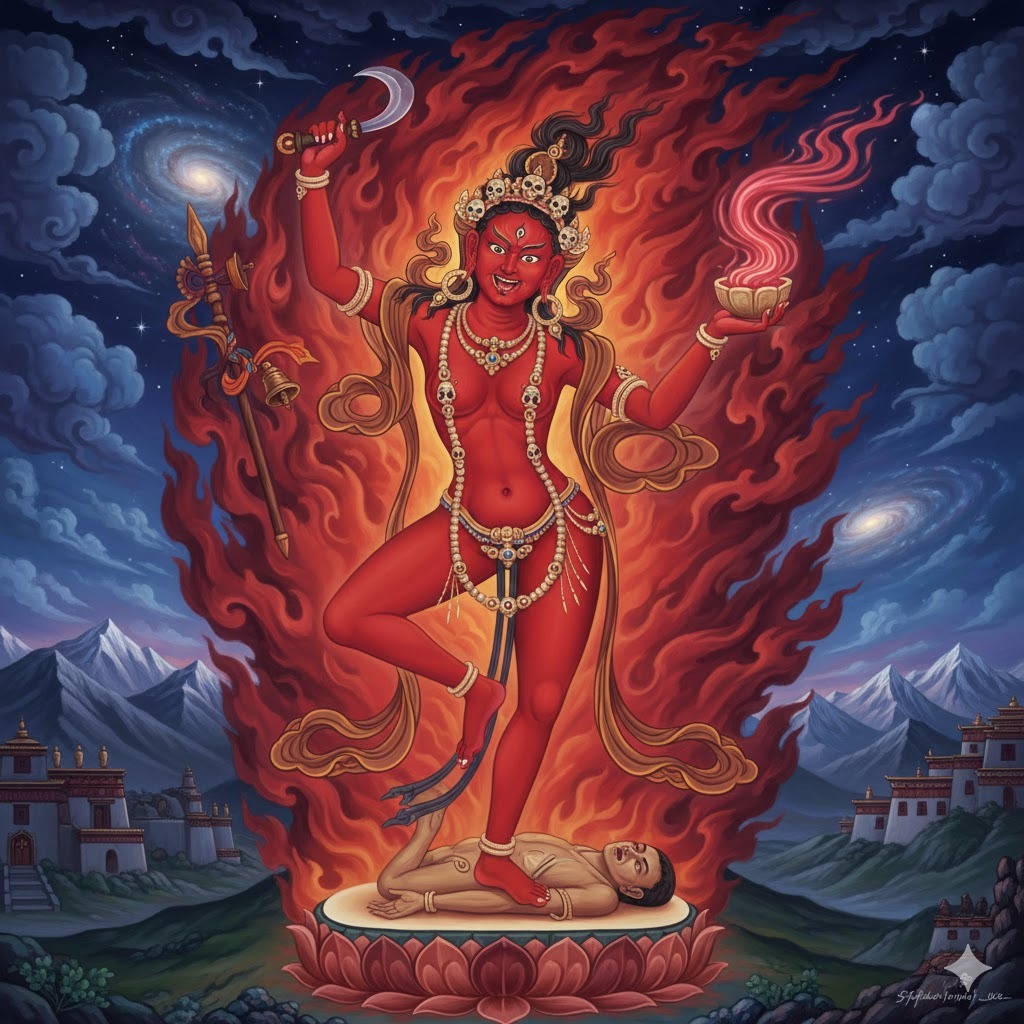
At first glance, Vajrayogini appears startling to those unfamiliar with Tantric iconography. She is depicted as a youthful, naked red figure, adorned with bone ornaments, standing in a dynamic pose. She holds a curved knife (kartika) in her right hand, symbolizing the cutting of all delusions, and a skullcup (kapala) filled with nectar in her left, representing the pure bliss of emptiness. A khatvanga, a tantric staff, leans against her left shoulder, signifying her consort, Heruka, and her non-duality with masculine wisdom. Her fiery aura and garland of human skulls are not meant to inspire fear but to illustrate her triumph over ego and death, and her passionate commitment to liberation. This iconography is a rich language, each detail pointing to profound philosophical truths and meditational practices.
Vajrayogini is a fully enlightened Buddha and a principal Yidam, or meditational deity, particularly central to the Sakya, Kagyu, and Gelug schools of Tibetan Buddhism. She is often seen as the female manifestation of the Buddha of Wisdom, Manjushri, or as the consort to Heruka Chakrasamvara. However, in many traditions, she is practiced as a solitary deity, meaning she herself contains the complete path to Buddhahood without needing a separate consort. This emphasizes her self-sufficient and ultimate nature. Her fierce aspect is a direct expression of her ability to cut through the most subtle delusions and obstacles that bind sentient beings to suffering. She is not wrathful in the sense of anger, but in the sense of being powerfully active and uncompromising in her benevolent purpose.
The practice of Vajrayogini is known for being an exceptionally swift path to enlightenment. This is largely due to its emphasis on transforming all aspects of ordinary experience our body, speech, and mind into their pure, divine counterparts. Practitioners learn to view their own body as Vajrayogini’s radiant form, their speech as her powerful mantra, and their mind as her profound wisdom. This radical transformation helps to dismantle the deeply ingrained habit of perceiving ourselves and the world as inherently solid and separate. By meditating on her pure form, practitioners cultivate an equally pure vision of themselves and all phenomena.
Central to her practice is the understanding of emptiness (sunyata) and bliss (maha-sukha). Vajrayogini is the embodiment of the non-duality of these two. Emptiness, in this context, is not a void but the ultimate nature of reality, free from inherent existence or fabricated qualities. Bliss refers to the extraordinary joy that arises when the mind is fully liberated from dualistic clinging. The union of these two, experienced through advanced yogic practices involving the subtle energy body (channels, winds, and drops), is the very essence of Vajrayogini’s realization and the goal of her practitioners. Her red color symbolizes her fiery passion and also the blazing inner heat (tummo) that generates this profound bliss.
The lineage of Vajrayogini is rich and diverse, with several distinct forms and practices, each stemming from different enlightened masters. The most widely practiced forms include Naro Kachö (from Naropa), Maitri Kachö (from Maitripa), and Indra Kachö (from Indrabhuti). Naro Kachö, in particular, is highly revered and practiced across all schools, known for its extensive sadhanas (meditation texts) and profound instructions. These lineages emphasize specific methods for achieving the illusory body and clear light, two crucial stages on the path to Buddhahood.
Initiation into Vajrayogini's practice requires a high Tantric empowerment (wang) from a qualified lama. This is not a casual undertaking but a serious commitment to an intensive spiritual path. Once initiated, practitioners engage in daily sadhana, mantra recitation, and complex visualizations. The commitment involves maintaining strict ethical vows and a consistent daily practice. It's not a practice to be approached lightly but with immense respect and dedication. The profound results are said to be commensurate with the effort and sincerity applied.
For those outside the inner circle of Tantric practitioners, understanding Vajrayogini offers insights into the ultimate potential of the human mind. She embodies the radical idea that enlightenment is not about suppressing our energies but about transforming them. Our passions, our drives, our very bodies, when seen through the lens of wisdom and compassion, become vehicles for liberation. She teaches that wisdom is not passive but dynamic, fiery, and fiercely compassionate, willing to dismantle anything that stands in the way of freedom for all beings. Her practice is a profound journey into self-transformation, revealing the inherent purity and awakened nature that lies within each of us, waiting to be fully realized.
Sera Jey Wisdom Center
A Gelug Tibetan Buddhist center in Jakarta. Join our weekly prayers every Saturday at 2 PM — everyone is welcome.
Address
Sera Jey Wisdom Center
Ruko Savoy Blok C1 No.31 & 32,
River Garden Jakarta Garden City,
Cakung Timur, Jakarta Timur 13910,
Indonesia
© 2026 Sera Jey Wisdom Center Jakarta. All rights reserved.