
Vajrasattva
Uncover the essence of Vajrasattva, the Buddha of Purification, whose practice is vital for cleansing negative karma and spiritual obscurations in Vajrayana Buddhism.
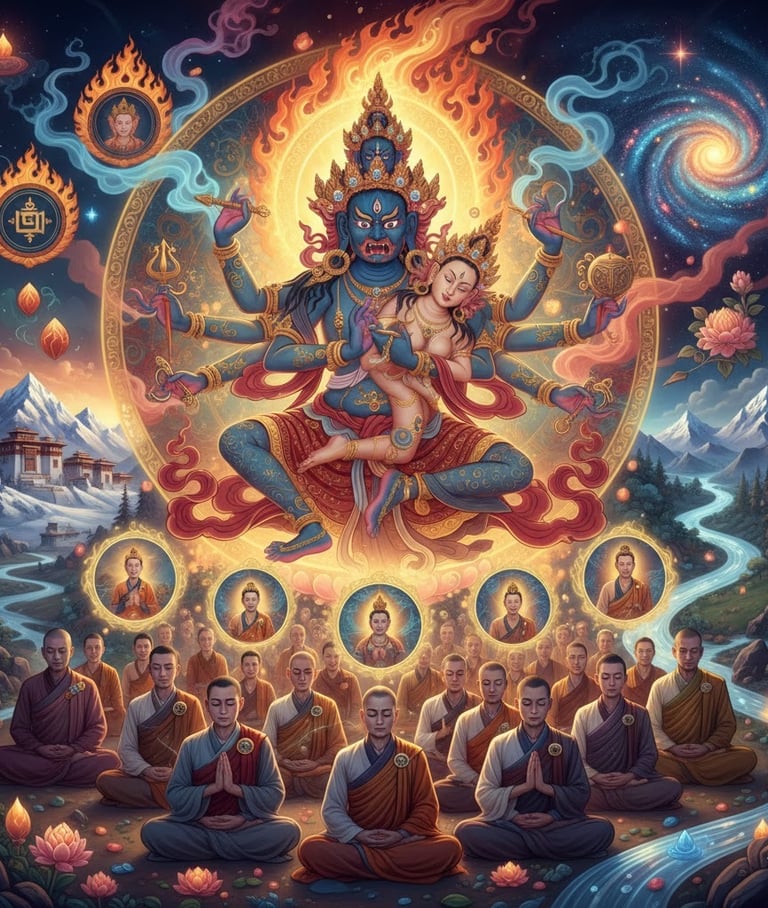
Vajrasattva, whose name translates to Adamantine Being or Diamond Nature, is one of the most significant and universally revered figures in the pantheon of Mahayana and, especially, Vajrayana Buddhism.
He stands as the embodiment of the purity of the enlightened mind, serving as the quintessential Buddha of purification. His practice is not merely supplementary but is often deemed indispensable for anyone seriously engaging with the sophisticated and potentially perilous path of Tantra, forming a foundational practice known as one of the four preliminary foundations or Ngondro. The core offering of Vajrasattva to the Buddhist faith is a direct, accelerated, and powerful method for cleansing the mindstream of all accumulated negative karma, obscurations, and breaches of spiritual vows (samaya), thereby paving the way for the profound realizations that follow.
The central concept surrounding Vajrasattva is that negative karma and emotional afflictions, though seemingly solid and real, are ultimately empty of inherent existence. They are products of ignorance and dualistic perception. Vajrasattva’s practice utilizes this profound understanding of emptiness, combined with the power of compassion and focused visualization, to dissolve these mental stains. He is typically depicted as white in color, symbolizing his pristine and unblemished nature. He sits in the full lotus posture, adorned with the silks and jewels of a Sambhogakaya Buddha, embodying the non-dual purity of the awakened state. In his right hand, held at the heart, he holds a golden vajra, representing the unbreakable, indestructible nature of reality (wisdom). In his left hand, resting on his hip, he holds a silver bell, symbolizing wisdom's expression in the form of compassion and the emptiness of all phenomena. The union of the vajra and the bell is the core philosophical statement of his being: the perfect, indivisible unity of wisdom and method.
For the practitioner, the practice of Vajrasattva is a disciplined and profound form of meditation and recitation known as Deity Yoga. The entire process hinges on four key powers, traditionally known as the Four Opponent Powers, which must be present for the purification to be complete and effective. These powers transform the mental landscape and ensure the karmic seeds are truly deactivated. The first power is the Power of Reliance or Refuge and Bodhichitta. This means taking refuge in the Three Jewels (Buddha, Dharma, Sangha) and generating the altruistic intention of Bodhichitta the wish to attain enlightenment for the benefit of all sentient beings. This foundational motivation ensures that the purification is aimed not at selfish relief, but at increasing one's capacity to help others. This orientation gives the practice its immense spiritual power.
The second power is the Power of Regret or Repentance. This is not guilt or self-hatred, which are crippling emotions. Instead, it is a genuine, clear-sighted realization of the harm caused by one's negative actions, thoughts, and words, both to others and to one's own spiritual progress. This heartfelt recognition, coupled with a deep sense of sorrow over the missed opportunities for virtue, is essential. Without authentic regret, the karmic seeds remain robust. The third power is the Power of the Antidote or Remedial Action. This is the active engagement in the purification practice itself, which is typically the visualization and mantra recitation of Vajrasattva. The meditator visualizes Vajrasattva above their head and invokes a stream of brilliant white, purifying nectar and light flowing down, entering their body, and completely washing away all sickness, negative karma, obscurations, and samaya breaches, which are visualized as dark, smoky liquids or crawling insects exiting the body. The mind is then left clear and spacious.
The mantra associated with this practice is the 100-Syllable Mantra (Yig Gya Ma). This mantra is considered one of the most comprehensive and powerful purification tools in the Vajrayana tradition. It is a long, complex sequence of syllables that invokes the essence of Vajrasattva and the entire lineage of purified awareness. Its comprehensive nature is believed to address and purify every single kind of negative action or spiritual transgression, even those committed unconsciously. The repetition of this mantra, often performed hundreds of thousands of times as part of the Ngondro preliminaries, serves to continually reinforce the visualization and impress the quality of purity upon the practitioner's mind. The meticulous, focused effort required to complete the mantra count helps to develop the concentration needed for higher Tantric practices.
The fourth and final power is the Power of Resolve or Vow Not to Repeat. After the purification is complete, the practitioner makes a strong, genuine commitment to avoid repeating the negative actions in the future, even if it is only for a short period, such as one day or one week. This resolve acts as a seal on the purification process, preventing the re-creation of the negative karmic seeds. It transforms the practice from a temporary cleansing into a genuine, lasting transformation of behavior and ethical conduct. Through the consistent application of these Four Opponent Powers, the practitioner dismantles the fundamental habits that perpetuate suffering and ignorance.
In the higher context of Tantra, Vajrasattva is not just an external figure to be invoked; he represents the unfabricated, primordial purity that is the true nature of the practitioner's own mind. The practice ultimately aims for the realization that the purifier (Vajrasattva), the act of purifying (the practice), and the purified (the practitioner’s mind) are all ultimately non-dual. This realization transcends the subject-object split, dissolving the illusion of a separate, flawed self being purified by an external Buddha. Vajrasattva is thus an ultimate teaching tool: a perfect, pure form used to eradicate the concept of imperfection, leading to the recognition of the mind’s innate, indestructible, diamond-like purity. His practice is the essential gateway, the spiritual detergent that prepares the mind for the direct contemplation and realization of ultimate reality. Without this purification, the higher Tantric practices are said to be like trying to pour fresh water into a filthy cup. Vajrasattva ensures the cup of the mind is perfectly clean and ready to receive the sublime nectar of supreme realization.
Sera Jey Wisdom Center
A Gelug Tibetan Buddhist center in Jakarta. Join our weekly prayers every Saturday at 2 PM — everyone is welcome.
Address
Sera Jey Wisdom Center
Ruko Savoy Blok C1 No.31 & 32,
River Garden Jakarta Garden City,
Cakung Timur, Jakarta Timur 13910,
Indonesia
© 2026 Sera Jey Wisdom Center Jakarta. All rights reserved.