
Vajrapani
Known as the "Lord of Secret Mysteries," Vajrapani represents the concentrated power of all the Buddhas. As one of the three foundational Bodhisattvas alongside Avalokiteshvara (Compassion) and Manjushri (Wisdom), he embodies the resolute energy required to cut through the dense fog of delusion and negative emotions.
Vajrapani, a name that resonates with profound power and symbolic weight within the intricate tapestry of Buddhist iconography, is far more than a mere deity; he is an archetypal representation of the Buddha’s power, energy, and unwavering resolve to destroy ignorance and overcome all obstacles on the path to enlightenment.
His name, derived from Sanskrit, translates directly to "Vajra in hand," the vajra being a mythical weapon, an adamantine thunderbolt, which is at once indestructible and capable of destroying all impediments. This potent symbol defines his essence, making him a central figure across various Buddhist traditions, particularly within Mahayana and Vajrayana Buddhism, where his fierce yet compassionate nature serves as a guiding force for practitioners.
The origins of Vajrapani can be traced back to early Indian Buddhism, where he appears as a protector of the Buddha. In the Pali canon, he is depicted as a powerful yaksha (nature spirit) who stands by the Buddha's side, ready to defend him against both earthly and supernatural threats. This early role as a guardian evolved significantly as Buddhism spread and diversified, especially with the rise of Mahayana and the later development of Vajrayana, or Tantric Buddhism. Within these traditions, Vajrapani shed much of his more localized, elemental characteristics to become a fully realized Bodhisattva, a being who has attained enlightenment but chooses to remain in the world to help others achieve the same state. His transformation reflects a deeper philosophical shift, where physical protection transmutes into spiritual safeguarding, and brute force evolves into the irresistible power of awakened awareness.
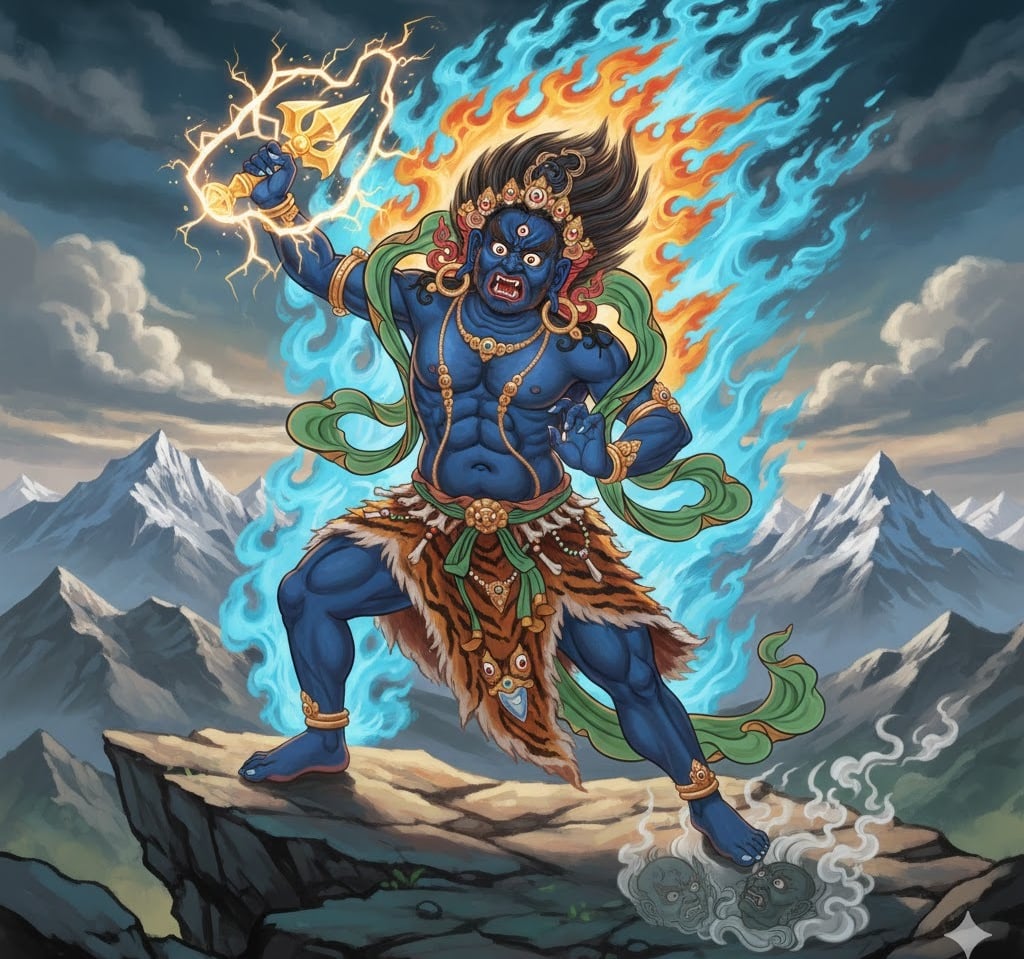
Visually, Vajrapani is almost universally depicted as a wrathful, yet magnificent, figure. He is typically shown standing in a dynamic posture, often in a warrior's stance, with his right hand raised, brandishing the formidable vajra. His left hand might perform a gesture of warning or hold a lasso, symbolizing his ability to bind and tame negative forces. His skin is frequently dark blue, a color that symbolizes the vastness of the sky, the emptiness of phenomena, and the unchangeable nature of truth. His expression is fearsome, with a wide mouth, sharp fangs, and bulging eyes, often crowned with flaming red hair standing on end. He wears a crown of skulls or five jewels, representing the transformation of the five delusions into the five wisdoms, and a garland of snakes, which are ancient symbols of energy and transformation, further emphasizing his dominion over powerful primal forces. His body is adorned with fierce ornaments, and he is often surrounded by a blazing aura of fire, symbolizing the burning away of ignorance and delusion. These wrathful attributes are not meant to inspire fear in the practitioner but rather to instill fear in their inner demons and obstacles, representing the intense and decisive energy required to cut through delusion.
In Mahayana Buddhism, Vajrapani is counted among the eight great Bodhisattvas, alongside figures like Avalokiteshvara (Chenrezig) and Manjushri. While Avalokiteshvara embodies compassion and Manjushri embodies wisdom, Vajrapani embodies the power of all Buddhas. He represents the vigorous application of the enlightened mind, the unyielding will to overcome adversity, and the energetic aspect of enlightenment. He is seen as the Bodhisattva who embodies the collective might and resolve of all the Buddhas, a powerful force that ensures the Dharma (Buddhist teachings) is protected and propagated. His role is to inspire courage in practitioners, remind them of their inner strength, and help them manifest the spiritual power needed to traverse the challenging path to liberation.
Within Vajrayana Buddhism, Vajrapani's significance deepens considerably. He is one of the "Three Family Protectors" or "Lords of the Three Families," along with Avalokiteshvara and Manjushri, each representing one of the principal qualities of an awakened being. Avalokiteshvara represents the compassion family (padma family), Manjushri represents the wisdom family (buddha family), and Vajrapani represents the power or action family (vajra family). This triad forms the core spiritual attributes necessary for enlightenment. In tantric practices, Vajrapani is frequently invoked as a meditational deity (yidam) to help practitioners develop inner strength, overcome fear, remove obstacles, and purify negative karma. Visualizing him and reciting his mantra are believed to help practitioners access his powerful energy, enabling them to transform anger and aggression into enlightened action and unwavering determination. His fierce appearance in this context is understood as a manifestation of skillful means, an expression of boundless compassion that uses potent imagery to shock the mind out of complacency and into active engagement with the path.
The symbolism of the vajra itself is crucial to understanding Vajrapani. The vajra, often translated as "thunderbolt" or "diamond," is an ancient Indian weapon that predates Buddhism, famously wielded by the Vedic deity Indra. In Buddhist iconography, it evolved into a sophisticated symbol. It is depicted as a symmetrical object with two sets of five prongs (or spokes) emanating from a central sphere, representing emptiness or the primordial state of unity. The prongs on each end symbolize the duality of phenomena—samsara and nirvana, subject and object—yet they are fundamentally connected, showing that these apparent dualities are inseparable and ultimately unified in enlightenment. Its "diamond-like" quality signifies its indestructibility and its ability to cut through anything, particularly ignorance, while remaining whole and unblemished. Its "thunderbolt" aspect represents its swift, decisive, and overwhelming power to awaken and transform. When Vajrapani wields the vajra, he signifies the active, dynamic, and irresistible force of enlightenment that shatters all illusions and establishes the unshakeable truth of reality.
In Tibetan Buddhism, Vajrapani is often encountered in various forms, including more esoteric tantric manifestations. He is deeply integrated into the lineage teachings and is a prominent figure in Thangka paintings and mandalas. He is considered a guardian of esoteric teachings and practices. Many stories and legends surrounding him highlight his unwavering commitment to protecting the Dharma and its practitioners. For instance, he is sometimes described as having received certain tantric teachings directly from the Buddha and subsequently transmitted them to human lineage holders, solidifying his role as a patron of Vajrayana. His presence in these traditions reinforces the idea that the path to enlightenment is not always gentle and passive; it requires fierce determination, active engagement, and the courage to confront and transform inner and outer obstacles.
Ultimately, Vajrapani serves as a powerful reminder that the spiritual journey demands more than just contemplation. It requires active energy, fierce dedication, and the relentless courage to face and conquer one's own limitations and delusions. He embodies the potent, dynamic, and unshakeable power of the enlightened mind—a power that is always available to those who cultivate wisdom, compassion, and the unwavering will to achieve liberation for the benefit of all beings. His wrathful aspect is a mirror, reflecting the intensity with which practitioners must engage in their spiritual practice, turning their inner turmoil and external challenges into fuel for profound transformation. He stands as a formidable guardian, not just of the Dharma, but of the practitioner's potential, ever ready to help them wield their own inner vajra against the forces that obscure their true nature.
Sera Jey Wisdom Center
A Gelug Tibetan Buddhist center in Jakarta. Join our weekly prayers every Saturday at 2 PM — everyone is welcome.
Address
Sera Jey Wisdom Center
Ruko Savoy Blok C1 No.31 & 32,
River Garden Jakarta Garden City,
Cakung Timur, Jakarta Timur 13910,
Indonesia
© 2026 Sera Jey Wisdom Center Jakarta. All rights reserved.