
Understanding Samantabhadra (Kuntu Zangpo) in Tibetan Buddhism
Discover Samantabhadra (Kuntu Zangpo), the Primordial Buddha and ultimate symbol of the Dharmakaya. Learn how this unadorned, dark blue figure embodies the inherent purity and perfect, timeless awareness (Rigpa) that is the true, non-dual nature of all reality, according to the profound teachings of Dzogchen.
In the vibrant and intricate tapestry of Tibetan Buddhism, few figures hold as profound and fundamental a significance as Samantabhadra, known in Tibetan as Kuntu Zangpo (meaning "All-Good" or "Always Auspicious"). Unlike many other Buddhas and Bodhisattvas who embody specific aspects of enlightenment or wisdom, Samantabhadra is unique. He is not merely a deity or a historical figure who achieved enlightenment; rather, he is considered the Primordial Buddha (Adibuddha), representing the absolute, unconditioned, and ultimate nature of reality itself. To understand Samantabhadra is to touch upon the very essence of Dzogchen, the Great Perfection, and the highest teachings of the Nyingma lineage.
The Adibuddha: Beyond Form and Concept
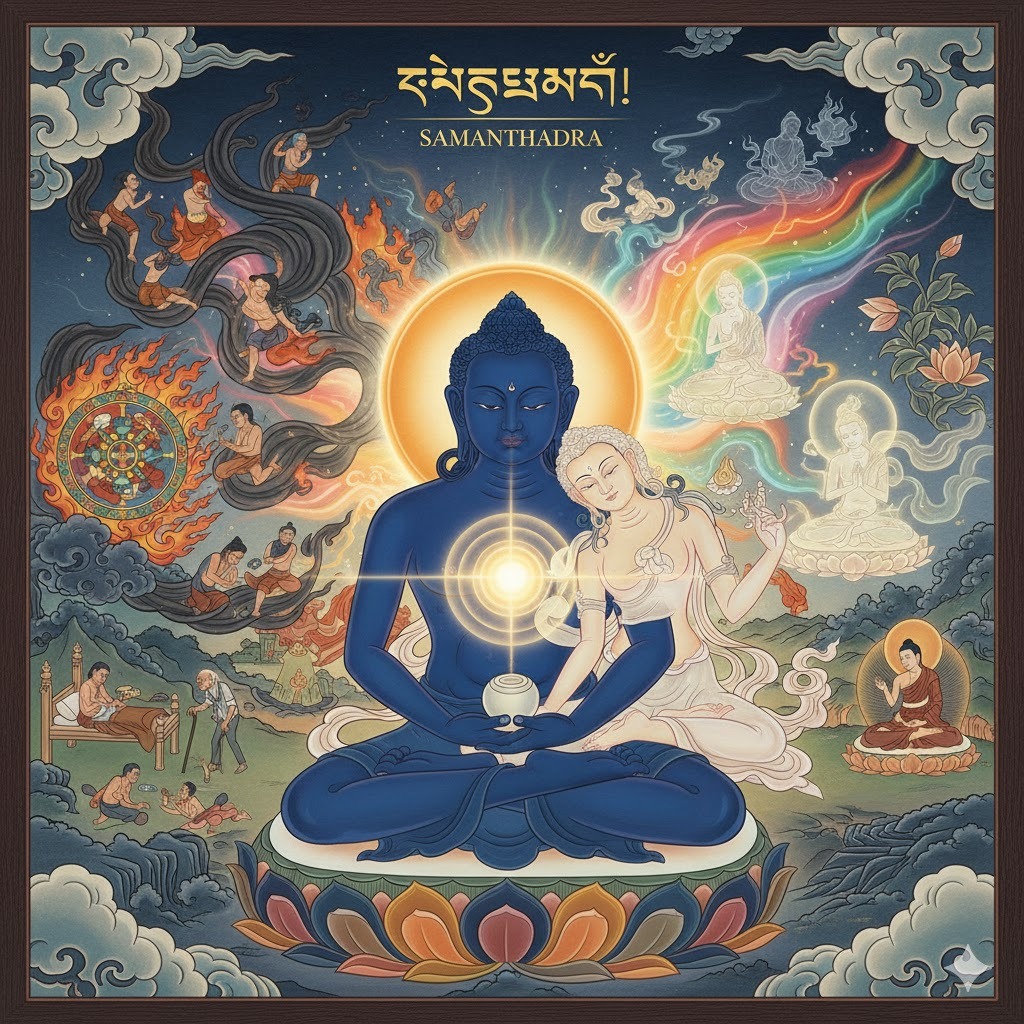
Samantabhadra's distinctiveness lies in his representation of the Dharmakaya, the truth body of a Buddha. The Dharmakaya is the formless, ultimate nature of enlightenment—the emptiness, luminosity, and unceasing compassion that is the ground of all existence. Because he embodies this formless truth, Samantabhadra is typically depicted as dark blue, naked, and without ornaments, seated in the vajra posture. This iconography is highly symbolic:
Dark Blue: Represents the boundless, all-pervading nature of space and the ultimate purity that transcends all conceptual categories. It is the color of ultimate reality, clear and vast.
Naked (Undorned): Signifies his primordial purity, free from the coverings of conceptual thought, defilements, and the elaborations of samsaric existence. He is as he is, unadulterated by any karmic imprints or mental constructs. He does not need clothes or jewels because his true nature is perfection itself.
Vajra Posture: A posture of profound meditation and unwavering stability, symbolizing his unchanging, unmoving presence as the ground of all being.
Alone (often depicted with Consort Samantabhadrī): When depicted alone, he represents the non-duality of clarity and emptiness. When depicted in Yab-Yum (father-mother union) with his consort Samantabhadrī (Kuntu Zangmo), their union symbolizes the inseparability of method (compassion, luminosity) and wisdom (emptiness, awareness). Samantabhadrī, depicted as white, represents pure wisdom, while Samantabhadra represents primordial awareness and emptiness. Their embrace is the ultimate non-dual state where all distinctions dissolve.
Samantabhadra is not a being who achieved enlightenment through effort over countless eons; rather, he is enlightenment itself, eternally present, inherently pure, and completely perfect from the very beginning. This is a crucial point for understanding the Dzogchen view, which posits that our own fundamental nature is already perfect, already enlightened, simply obscured by temporary defilements.
The Dzogchen Perspective: Inherent Purity
Within the Nyingma school, particularly in the context of Dzogchen, Samantabhadra serves as the ultimate symbol and reference point for the primordial state of Buddhahood that is the true nature of every sentient being. Dzogchen teaches that we are not trying to become Buddha; we are trying to realize that we already are Buddha. This inherent Buddhahood is what Samantabhadra embodies.
The Dzogchen tradition speaks of Rigpa, which is often translated as "pristine awareness" or "primordial awareness." This Rigpa is our true nature—empty, luminous, and all-pervading. Samantabhadra is the personification of this Rigpa, utterly free from the dualities of subject and object, samsara and nirvana. He represents the Ground (gzhi)—the primordial basis from which all phenomena arise, yet which remains unstained and unchanged.
From this perspective, our suffering and confusion are not inherent flaws in our being, but rather temporary obscurations, like clouds temporarily covering the sun. The sun (our true nature, Samantabhadra) is always there, always radiant. The path of Dzogchen is to recognize and abide in this inherent, primordial purity.
The Samantabhadra Prayer: A Call to Recognition
One of the most profound and widely recited texts associated with Samantabhadra is the "Prayer of Samantabhadra" (or "Aspiration Prayer of Samantabhadra"). This text, traditionally attributed to Samantabhadra himself, is a quintessential Dzogchen teaching. It articulates the origin of both samsara (cyclic existence) and nirvana (liberation) from the same ground, explaining how beings fall into confusion and how they can achieve liberation through recognizing their true nature.
The prayer describes how, from the primordial pure ground, an initial impulse of ignorance (lack of recognition of one's true nature) leads to dualistic grasping, karma, and the cycle of rebirth. Conversely, those who recognize the inherent purity and non-duality of the ground achieve liberation. It is a powerful aspiration to recognize the "single ground, two paths, two results" (gzhi gcig lam gnyis 'bras bu gnyis).
Reciting this prayer is not merely an act of devotion but a powerful contemplation on the nature of mind, awakening, and delusion. It serves as a reminder of our own inherent Buddhahood and a plea to recognize it for the benefit of all beings.
Samantabhadra in the Context of Guru Yoga and Lineage
While Samantabhadra represents the ultimate, formless truth, he is also crucial in understanding the lineage of transmission in Dzogchen. The Nyingma tradition traces its lineage back to Samantabhadra as the source of all Dzogchen teachings, transmitting them through Vajrasattva, Garab Dorje (the first human Dzogchen master), and down through a continuous line of enlightened masters.
In Guru Yoga practices, meditators often visualize their root guru as inseparable from Samantabhadra, recognizing that the wisdom and compassion of the guru are ultimately expressions of the primordial wisdom of the Dharmakaya. This links the ultimate, formless truth directly to the living, breathing teacher, making the profound accessible.
Samantabhadra vs. Samantabhadra Bodhisattva
It is important to distinguish the Primordial Buddha Samantabhadra (Kuntu Zangpo) from Samantabhadra Bodhisattva, who appears prominently in Mahayana Buddhism, particularly in the Lotus Sutra and Avatamsaka Sutra (Flower Garland Sutra).
Samantabhadra Bodhisattva: This figure is one of the "Four Great Bodhisattvas" of Mahayana, known for his vast vows, extensive good deeds, and fierce commitment to fulfilling the aspirations of all sentient beings. He is typically depicted riding a white elephant with six tusks, symbolizing his power and purity in overcoming obstacles. His vows emphasize practice and action, encouraging practitioners to follow his example in making profound aspirations and engaging in virtuous conduct.
Samantabhadra (Kuntu Zangpo) - The Primordial Buddha: As discussed, this is the ultimate, formless aspect of enlightenment, the Dharmakaya itself, the ground of being. He represents the inherent perfection that is the source of all Buddhas and the true nature of all phenomena.
While both figures share the name Samantabhadra and embody aspects of ultimate goodness, their roles and representations are distinct within the different levels of Buddhist teaching. The Primordial Buddha Samantabhadra is central to the ultimate view of Dzogchen, while Samantabhadra Bodhisattva is a key figure in the Mahayana path of accumulating merit and wisdom through vast and compassionate actions.
The Practical Implication: Rest in Your True Nature
For practitioners, understanding Samantabhadra is not just about abstract philosophy. It has profound practical implications. It serves as a constant reminder that liberation is not something external to be acquired, but a state of being to be recognized. The realization of Samantabhadra's nature is the realization of one's own ultimate nature.
This realization leads to a profound sense of ease and freedom, as the endless struggle to "become" something is seen as futile. Instead, the practice becomes one of relaxing into and abiding in the already-present primordial purity. This doesn't mean passively doing nothing; rather, it means all actions arise spontaneously from this unconditioned ground, infused with natural compassion and wisdom, free from grasping and effort.
The Unfolding of the All-Good
Samantabhadra (Kuntu Zangpo) stands as a beacon of primordial purity, the ultimate source and ground of all existence in Tibetan Buddhism, especially within the Dzogchen tradition. He represents the unconditioned, timeless, and perfect nature of our own mind, always present, always radiant, awaiting recognition.
To contemplate Samantabhadra is to contemplate the very essence of awakening—not as a distant goal, but as an ever-present reality. It is an invitation to look beyond the transient forms and concepts, to dive into the vast, luminous, and empty expanse of our own true being, and to rest in the boundless goodness that is eternally ours. The teachings of Samantabhadra remind us that the path to enlightenment is ultimately the path of remembering who we already are.
Sera Jey Wisdom Center
A Gelug Tibetan Buddhist center in Jakarta. Join our weekly prayers every Saturday at 2 PM — everyone is welcome.
Address
Sera Jey Wisdom Center
Ruko Savoy Blok C1 No.31 & 32,
River Garden Jakarta Garden City,
Cakung Timur, Jakarta Timur 13910,
Indonesia
© 2026 Sera Jey Wisdom Center Jakarta. All rights reserved.