
The Wheel of Time: Unlocking the Mysteries of Kalachakra
Unlock the mysteries of Kalachakra, the "Wheel of Time." This deep dive explores how ancient Buddhist wisdom connects the movements of the cosmos to the rhythms of the human body. From the legendary kingdom of Shambhala to the symbolism of the sand mandala, discover how mastering the cycles of time can offer profound peace in a chaotic modern world.
The Wheel of Time: Unlocking the Mysteries of Kalachakra
In the vast and intricate pantheon of Vajrayana Buddhism, few figures command as much awe, complexity, and reverence as Kalachakra. Known as the deity of the Wheel of Time, Kalachakra represents not merely a god to be worshipped, but a profound philosophical system that maps the entire cosmos, the human body, and the path to enlightenment onto the fabric of time itself. While many Buddhist teachings focus on transcending the temporal world, the Kalachakra Tantra embraces it, weaving astronomy, history, physiology, and soteriology into a singular, grand vision. In a modern world obsessed with time management yet deeply anxious about the passage of time, the ancient wisdom of Kalachakra offers a radical shift in perspective. It invites us to stop fighting the clock and instead understand time as the very vehicle of our liberation.
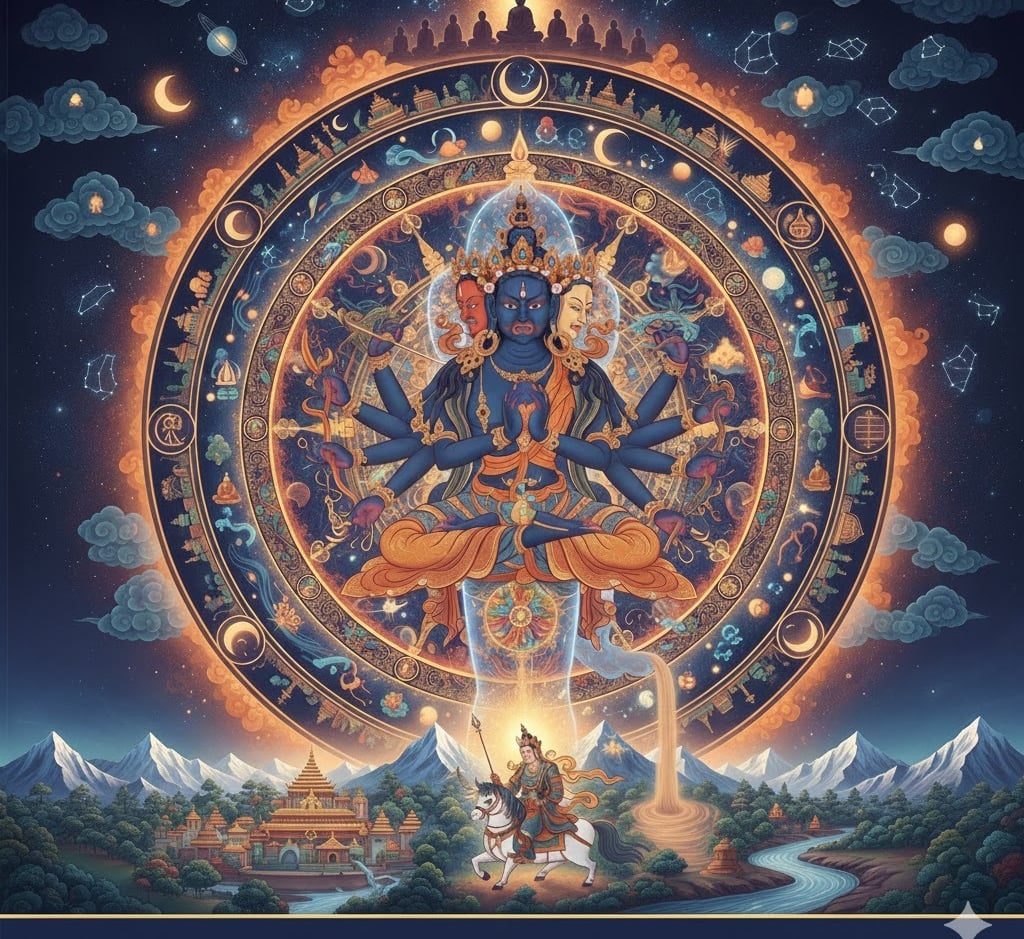
To encounter the visual representation of Kalachakra is to be confronted with a dazzling array of symbolism that defies simple interpretation. He is typically depicted in a state of ecstatic union with his consort, Vishvamata, the Mother of the Universe. This imagery, known in Tibetan as Yab-Yum or father-mother, is not sexual in the mundane sense but is a metaphysical blueprint representing the indivisible union of method and wisdom, or compassion and emptiness. Kalachakra himself is usually dark blue, symbolizing the unchanging nature of the absolute, while Vishvamata is golden or yellow, representing the wisdom that realizes the nature of reality.
The complexity of the deity’s form is staggering and intentional, serving as a mnemonic device for the practitioner to visualize the multifaceted nature of reality. Kalachakra is often depicted with four faces and twenty-four arms, holding a vast array of weapons and ritual implements. Each face looks in a different direction and corresponds to a different aspect of existence. The central face is usually black or dark blue, representing the wrathful aspect of ultimate reality. The right face is red, symbolizing passion and the sublimation of desire. The back face is yellow, representing stability and earth, while the left face is white, symbolizing peace and water. These colors are not arbitrary; they map onto the elements, the cardinal directions, and the psychological states that must be transformed on the path to awakening. The twenty-four arms hold implements ranging from vajras and swords to lotus flowers and jewels, signifying the deity’s power to cut through ignorance, protect the practitioner, and bestow spiritual wealth.
The philosophy underpinning this visual grandeur is divided into three distinct yet interconnected levels: the Outer Kalachakra, the Inner Kalachakra, and the Alternative (or Other) Kalachakra. Understanding this tripartite structure is essential to grasping why this deity is called the Wheel of Time. The Outer Kalachakra deals with the external world—the macrocosm. It encompasses the movements of the planets, the cycles of the sun and moon, the changing of the seasons, and the history of nations. It is here that Buddhism intersects with ancient astronomy and astrology. The system posits that the external universe is a rhythmic, cyclical entity, breathing in and out in vast epochs of time. Unlike the modern linear view of time which marches relentlessly from a lost past to an uncertain future, the Outer Kalachakra views time as cyclical, a wheel that turns endlessly. This perspective aligns the practitioner with the natural rhythms of the universe, fostering a sense of connection to the cosmos rather than alienation from it.
Mirrored within the human being is the Inner Kalachakra. If the Outer level is the macrocosm, the Inner level is the microcosm. This aspect of the teaching maps the external universe onto the subtle physiology of the human body. It details the complex network of energy channels (nadis), winds (prana), and drops (bindus) that animate our physical form. The text explains how the movement of our breath and the flow of our psychophysical energy correspond directly to the movement of the planets and the passage of days and years. For instance, the number of breaths a person takes in a day is said to correlate with astronomical coordinates. This creates a profound biological basis for the idea that we are not separate from the universe. We are, quite literally, the universe breathing. The suffering we experience illness, anxiety, emotional turbulence is understood as a misalignment or blockage in these subtle energies, a discord between the inner and outer wheels.
The third level, the Alternative Kalachakra, is the practice itself. This is the medicine applied to the diagnosis of the Outer and Inner levels. It consists of the initiations, visualizations, and yoga practices undertaken by the yogi to purify the mind and body. The goal of the Alternative Kalachakra is to synchronize the inner wheel of the body with the outer wheel of the cosmos and then to transcend both. By gaining control over the subtle winds and drops within the body, the practitioner stops the "winds of karma" that drive the cycle of uncontrolled rebirth. In this state of suspended animation and heightened awareness, the yogi realizes the state of empty-form, stepping off the wheel of suffering and becoming the master of time rather than its victim. This transformation is the ultimate alchemy, turning the lead of a mundane life into the gold of enlightenment.
A unique and captivating element of the Kalachakra tradition is its intrinsic connection to the mythical kingdom of Shambhala. Unlike other Buddhist tantras that are often set in timeless celestial realms, the Kalachakra is firmly rooted in a pseudo-historical context. Legend holds that the Buddha first taught this tantra at the request of King Suchandra of Shambhala. This hidden kingdom, said to exist somewhere in the high Himalayas or perhaps in a parallel dimension accessible only to the pure of heart, serves as a repository for these teachings. The Shambhala myth is not merely a fairy tale of a utopia; it contains a potent eschatological prophecy. It speaks of a future time when the world will be overrun by barbarians and ideologies of materialism and violence. When truth and spirituality are on the brink of extinction, the King of Shambhala will ride forth with a spiritual army to defeat the forces of ignorance and usher in a new Golden Age.
This narrative gives the Kalachakra a socio-political dimension that is rare in high tantra. It frames the spiritual path not just as a personal journey to nirvana but as a contribution to cosmic history and global peace. This is why the Dalai Lama, the most prominent holder of the Kalachakra lineage, has conferred the Kalachakra initiation more times than any other master in history, often to huge crowds numbering in the hundreds of thousands. He explicitly frames these gatherings as prayers for world peace. The logic is that by planting the seeds of compassion and wisdom in the minds of thousands of people, the collective consciousness of humanity can be shifted away from conflict and toward harmony. The initiation is a mass ritual of pacification, intended to heal the aggressive tendencies of the modern age.
Central to these public rituals is the creation of the Kalachakra sand mandala. This intricate palace of the deity is painstakingly constructed over several days by monks using millions of grains of colored sand. The mandala is a geometric representation of the Kalachakra deity's divine residence, a two-dimensional map of a multi-dimensional reality. Every line, color, and symbol in the mandala corresponds to a specific aspect of the philosophy. The viewer who gazes upon it is said to receive a blessing merely through the act of seeing. However, the most poignant moment of the ritual comes at the very end. After days of intense labor to create this masterpiece of beauty and precision, the mandala is ritualistically destroyed. The monks sweep the sand into a chaotic pile, symbolizing the impermanence of all constructed things. The sand is then carried in a procession to a nearby river and poured into the water, dispersing the blessings to the ocean and the world. This act serves as a visceral reminder that even the most sublime spiritual structures are transient, and that true freedom lies in non-attachment.
In our contemporary context, the figure of Kalachakra resonates with unexpected force. We live in an age defined by the tyranny of time. We are ruled by deadlines, schedules, and the accelerating pace of technological change. We often feel that time is running out, both in our personal lives and for the planet itself. The Kalachakra Tantra validates this anxiety but offers a solution that does not involve merely slowing down. It suggests that by understanding the deep, fractal connection between our own biological rhythms and the larger rhythms of the universe, we can find a stationary point at the center of the turning wheel. It teaches that time is not an external container that traps us, but a manifestation of our own mind. If we change our mind, we change our time.
Furthermore, the "interconnectedness" championed by the Kalachakra where astronomy, biology, and spirituality are fused parallels modern scientific understandings of systems theory and ecology. Just as the butterfly effect in chaos theory suggests that small changes can have vast consequences, the Inner Kalachakra suggests that shifting a single thought or breath can ripple out to affect the cosmos. This empowers the individual with a sense of agency. We are not insignificant specks of dust in a cold, mechanical universe; we are integral gears in the divine machine of the Wheel of Time.
Ultimately, Kalachakra stands as a testament to the sheer ambition of the human spirit to understand its place in existence. It is a system that refuses to compartmentalize reality. It demands that we look at the stars, look at our own bodies, and look at the nature of our minds, and see them all as reflections of a single, luminous truth. Whether one approaches it as a devout Buddhist practitioner, a student of mythology, or simply a seeker of wisdom, the figure of Kalachakra offers a profound reassurance: that even in the darkest times, the wheel is still turning, and within the cycles of destruction, the seeds of a new golden age are always waiting to be born.
Sera Jey Wisdom Center
A Gelug Tibetan Buddhist center in Jakarta. Join our weekly prayers every Saturday at 2 PM — everyone is welcome.
Address
Sera Jey Wisdom Center
Ruko Savoy Blok C1 No.31 & 32,
River Garden Jakarta Garden City,
Cakung Timur, Jakarta Timur 13910,
Indonesia
© 2026 Sera Jey Wisdom Center Jakarta. All rights reserved.