
The Historical Buddha (Siddhartha Gautama)
Discover the transformative journey of Siddhartha Gautama, the prince who abandoned a life of luxury to seek an end to universal suffering. This exploration delves into his transition from asceticism to the discovery of the Middle Way, his ultimate enlightenment beneath the Bodhi tree, and the profound psychological legacy he left for humanity. By examining the core tenets of his teachings and the enduring symbols of his awakening, we uncover why the historical Buddha remains a vital guide for self-liberation and mental clarity in the modern world.
The story of Siddhartha Gautama, the historical figure who would become known as the Buddha, is a narrative that weaves together the threads of human suffering, profound renunciation, and ultimate psychological liberation.
Born into the Shakya clan in the foothills of the Himalayas around the 5th or 6th century BCE, his life began within the gilded walls of a palace in Lumbini. As a prince, Siddhartha was shielded from the harsh realities of existence by his father, King Suddhodana, who sought to ensure his son would become a great monarch rather than a spiritual leader. This early environment of extreme luxury serves as a critical thematic contrast to the asceticism he would later adopt, illustrating the Buddhist middle way through the lens of his personal transition from one extreme of indulgence to another of total deprivation.
The turning point of Siddhartha’s life, and consequently the birth of one of the world's major religions, occurred during his venture outside the palace walls. It was here that he encountered the Four Sights: an old man, a sick person, a corpse, and a wandering ascetic. These experiences shattered his sheltered worldview, forcing him to confront the universal truth of dukkha, or suffering. The realization that youth, health, and life itself are transient pushed him toward a radical decision. At the age of twenty-nine, he abandoned his royal inheritance, his wife, and his newborn son to live as a forest-dwelling seeker. This act of renunciation is not merely a biographical detail but a cornerstone of Buddhist philosophy, representing the necessary detachment from the ego and worldly desires to find a truth that is not subject to decay.
For six years, Siddhartha practiced extreme asceticism, pushing his body to the brink of starvation and exhaustion alongside other forest sages. He mastered the most advanced meditative techniques of his era but found that they offered only temporary escape rather than a permanent solution to the problem of suffering. His realization that self-mortification was as much a dead end as self-indulgence led him to the discovery of the Middle Way. By accepting a bowl of milk rice from a village girl named Sujata, he regained the physical strength necessary for the final push toward enlightenment. This transition underscores a fundamental Buddhist tenet: that the mind cannot achieve clarity if the body is broken, just as a stringed instrument cannot produce music if the string is too tight or too loose.
The culmination of his journey took place under the spreading branches of a Pipal tree, now known as the Bodhi tree, in Bodh Gaya. Vowing not to rise until he had found the answer to the cessation of suffering, he entered a deep state of meditation. During this night, he is said to have faced the internal demons of Mara—personifications of desire, fear, and ego. By dawn, he had attained Nirvana, a state of complete awakening and liberation from the cycle of rebirth. At this moment, Siddhartha Gautama became the Buddha, the "Awakened One." His enlightenment provided the blueprint for the Four Noble Truths and the Eightfold Path, which form the structural integrity of Buddhist thought and practice.
The historical Buddha’s importance to Buddhism cannot be overstated; he is the supreme physician who diagnosed the human condition and prescribed a cure. Unlike many religious figures who claimed divine status or revelation from a god, the Buddha presented himself as a human being who had solved a human problem through human effort. This humanistic approach shifted the focus of spiritual life from external ritual and animal sacrifice to internal psychological transformation. By teaching that anyone, regardless of caste or gender, could achieve the same state of liberation, he challenged the rigid social hierarchies of ancient India and democratized the pursuit of holiness.
The Buddha mattered, and continues to matter, because he provided a systematic methodology for understanding the mind. His teachings on Anicca (impermanence) and Anatta (non-self) were revolutionary, suggesting that the "I" we strive so hard to protect is a fluid process rather than a static entity. This insight serves as a powerful antidote to the anxieties of the modern age. He mattered because he moved spirituality away from the realm of blind faith and into the realm of empirical experience, famously telling his followers to "come and see" for themselves rather than believing his words out of respect. This "ehipassiko" quality of his teaching bridged the gap between ancient philosophy and what many today recognize as a form of proto-psychology.
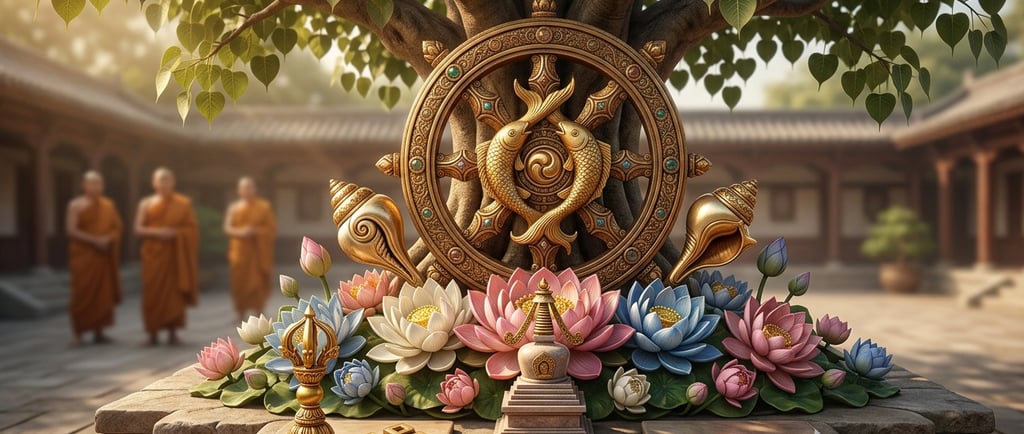
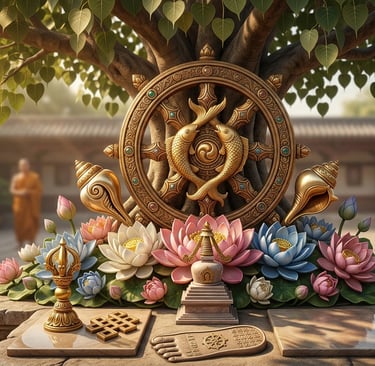
Symbolically, the Buddha represents the infinite potential of the human spirit to transcend its limitations. In Buddhist art and iconography, his image is often depicted with a faint smile, symbolizing the peace that comes from the cessation of craving. The elongated earlobes in his statues are symbols of his royal past, where he wore heavy gold jewelry, now empty to show his renunciation of material wealth. The various mudras, or hand gestures, associated with his life such as the earth-touching gesture at the moment of his enlightenment serve as a visual language for his teachings. These symbols remind practitioners that the path he walked is a map for their own internal journeys.
Even his passing, known as the Parinirvana, carries immense weight in the tradition. At the age of eighty, lying between two Sal trees, his final words were an exhortation to his disciples: "All conditioned things are subject to decay. Strive for your own liberation with diligence." This final lesson on impermanence capped a life dedicated to the removal of delusion. The historical Buddha remains a towering figure not because he founded an institution, but because he pointed toward a universal truth about the nature of the human heart. His legacy is the enduring promise that through mindfulness, ethical conduct, and wisdom, the cycle of suffering can be broken, and a lasting peace can be found within the present moment.
Sera Jey Wisdom Center
A Gelug Tibetan Buddhist center in Jakarta. Join our weekly prayers every Saturday at 2 PM — everyone is welcome.
Address
Sera Jey Wisdom Center
Ruko Savoy Blok C1 No.31 & 32,
River Garden Jakarta Garden City,
Cakung Timur, Jakarta Timur 13910,
Indonesia
© 2026 Sera Jey Wisdom Center Jakarta. All rights reserved.