
The Four Heavenly Kings: Virūpākṣa (West)
A profound journey into the Western quarter of the cosmos to meet Virūpākṣa, the red-skinned Heavenly King whose wide-eyed gaze and sacred serpent teach us the power of spiritual vision and the mastery of the senses.
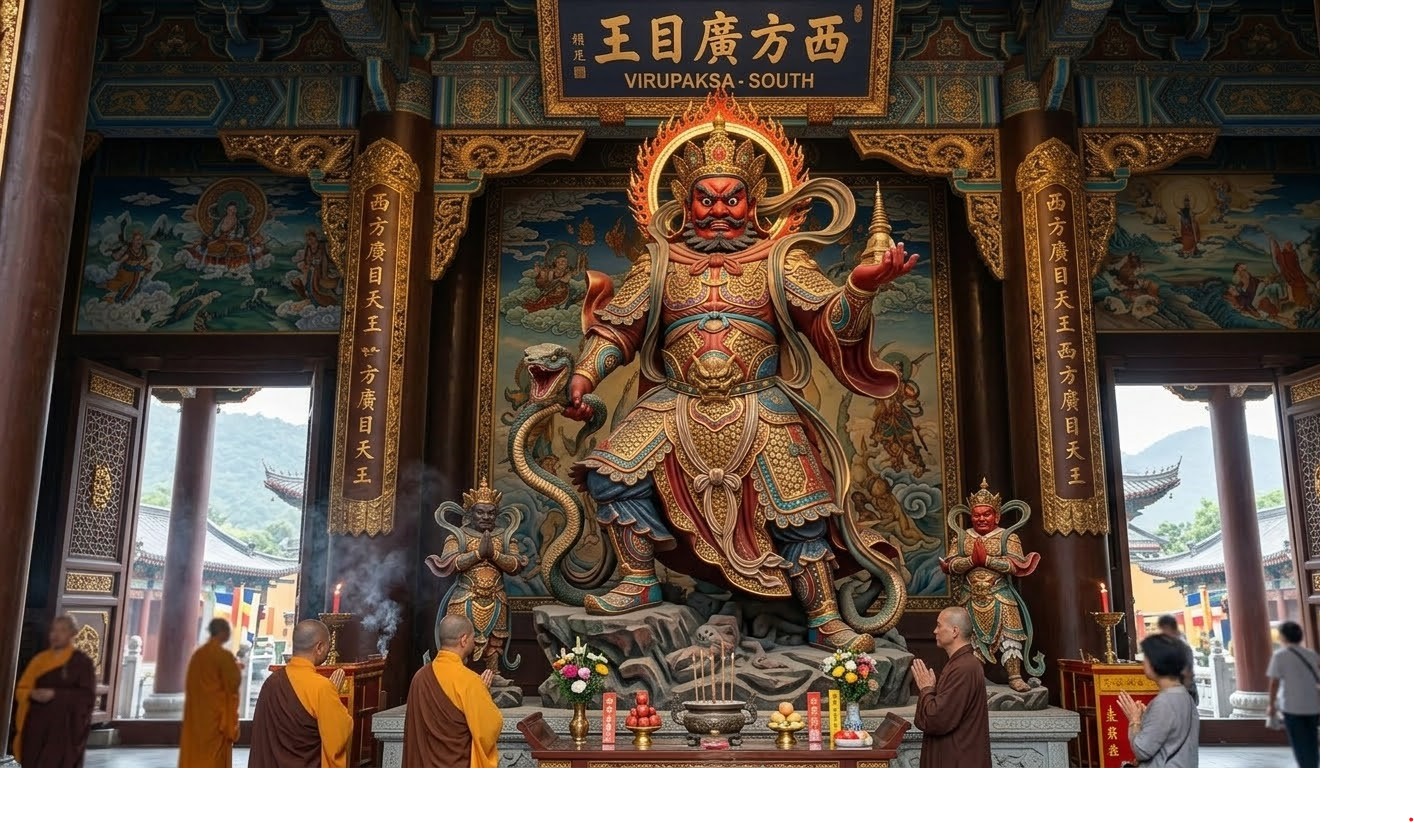
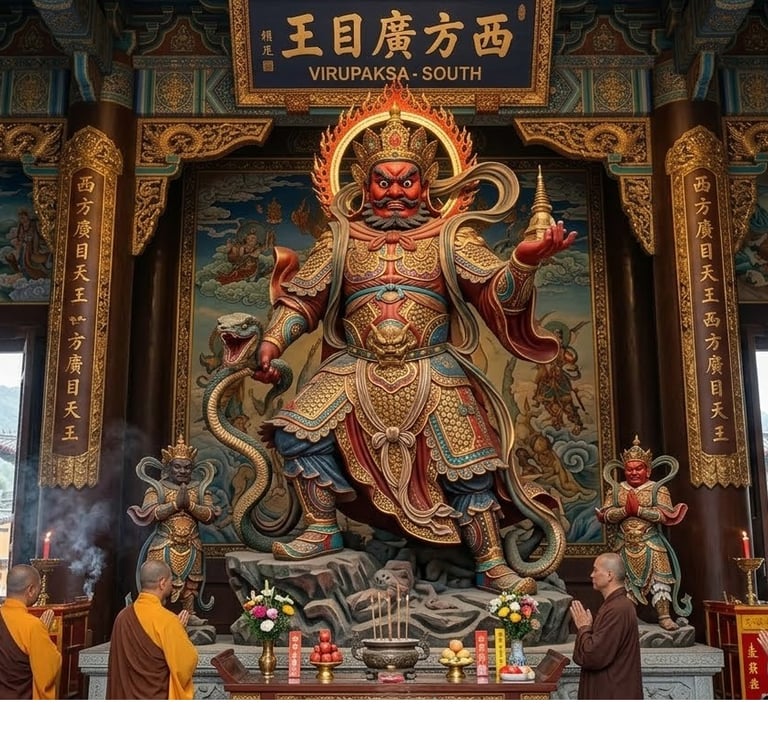
Virūpākṣa (West): The red, wide-eyed figure holding the serpent.
The vast expanse of the Buddhist cosmos is anchored by the presence of the Four Heavenly Kings, the Lokapālas, who stand as the eternal sentinels of the Dharma at the four cardinal directions of Mount Meru. While their collective duty is to safeguard the world from chaotic forces, each king offers a unique lesson through his specific attributes, elemental associations, and physical appearance. Moving our focus to the West, we encounter Virūpākṣa, a figure of staggering intensity and profound wisdom. Clad in ornate, celestial armor and possessing a complexion the color of a setting sun or burning embers, Virūpākṣa is the sovereign of the Western direction. His name, often translated as "He who sees all" or "The Wide-Eyed," hints at his primary spiritual function: the cultivation of unerring vision and the ability to perceive the hidden truths of the universe that lie beneath the surface of material reality.
Virūpākṣa’s most striking physical feature is his wide, penetrating eyes, which are said to never blink and never turn away from the truth. In the realm of spiritual practice, these eyes represent the development of the "Divine Eye," a state of consciousness that allows one to see the interconnectedness of all things and the inescapable law of cause and effect. While the physical world often presents us with a fractured and chaotic view of existence, the gaze of the Western King pierces through these illusions. He reminds the seeker that nothing is hidden from the universe and that true wisdom begins with the courage to look directly at one’s own nature, including the shadows that we often try to ignore. His red hue is not a sign of worldly anger, but rather the heat of transmutation, the fire that burns away the dross of the ego to reveal the gold of the spirit.
In his hands, Virūpākṣa typically holds a serpent or a naga, often appearing as a jewel-bearing snake that coils around his arm or rests within his grasp. This iconography is rich with layers of meaning, particularly regarding the mastery of one’s internal energy and the purification of the senses. In many Eastern traditions, the serpent represents the potent, often dangerous forces of desire and the subterranean energies of the psyche. By holding the serpent with calm authority, Virūpākṣa demonstrates that the goal of the spiritual path is not to destroy our innate drives or the "serpent" of our life force, but to master and direct it toward enlightenment. The serpent also symbolizes the Nagas, the ancient water deities and guardians of hidden treasures, over whom Virūpākṣa holds dominion. This signifies his role as the keeper of the "hidden jewels" of the Dharma, the profound insights that are only accessible to those who have tamed their wilder impulses.
The Western direction, over which Virūpākṣa presides, is traditionally associated with the element of fire and the time of sunset. This is the period of transition where the busyness of the day gives way to the stillness of evening, a time for reflection and the assimilation of experience. Virūpākṣa encourages us to use this "sunset" energy to look back at our actions with the clarity of his wide-eyed vision. The West is also the direction of the Pure Land of Sukhavati, the realm of Amitābha Buddha. Thus, Virūpākṣa acts as a gateway guardian to the land of Infinite Light. He suggests that before we can enter the state of ultimate peace and liberation, we must first pass the test of his gaze, we must be willing to see our lives with total honesty and assume responsibility for the "serpent" of our karma.
To engage with the energy of Virūpākṣa is to commit to a life of mindfulness and sensory discipline. As the King of the Nagas, he understands the slippery and elusive nature of the mind. Just as a snake can easily slip through one’s fingers, our thoughts and desires often evade our control, leading us into cycles of craving and aversion. Virūpākṣa teaches the practitioner how to hold the "snake" without being bitten. This is the art of detachment engaging with the world and its beauty without becoming ensnared by it. His presence in the temple entrance serves as a reminder to leave behind the "flickering tongue" of gossip, falsehood, and distraction, and to instead cultivate a steady, unwavering focus on the path ahead.
The wide eyes of the Red King also serve as a protective force for the community and the practitioner’s inner sanctum. It is said that his gaze alone can repel malevolent influences and clear the air of spiritual stagnation. In a modern context, this translates to the power of awareness as a tool for mental health and stability. When we are aware of a negative thought pattern as it arises, its power over us diminishes. By channeling the "Wide-Eyed" energy of Virūpākṣa, we develop an early warning system for our own mental states. We become the watchers of our own internal Western gate, ensuring that only thoughts and intentions that lead to growth and harmony are allowed to take root.
Culturally, Virūpākṣa is revered across various nations, known as Kōmoku-ten in Japan and Guăngmù Tiānwáng in China. In these traditions, he is often depicted standing upon a demon or a corrupted spirit, symbolizing the triumph of enlightened vision over the "demons" of spiritual blindness. This imagery is not meant to depict an external battle, but the internal victory of clarity over confusion. The "demon" beneath his feet represents the heavy, grounding weight of ignorance that prevents the soul from ascending. By stepping upon this ignorance, Virūpākṣa elevates himself and the seeker, showing that wisdom is the foundation upon which true power is built. The serpent he holds often carries a wish-fulfilling jewel, symbolizing that when we master our lower nature, we gain access to the infinite riches of the enlightened mind.
The relationship between the Red King and the serpent also highlights the Buddhist concept of transformation. In many stories, Nagas are beings that can be either fierce or benevolent, depending on how they are treated and guided. Similarly, our human emotions and desires are not inherently "bad," but they require the firm and steady hand of a guardian like Virūpākṣa to be transformed into vehicles for wisdom. His red color reminds us that this transformation is an active, energetic process. It requires the "fire" of Tapas, spiritual heat and discipline to melt down the cold, rigid structures of the ego so that the fluid, serpentine energy of the soul can flow toward its divine source.
As we stand before the image of Virūpākṣa, we are invited to consider what we are currently choosing to see and what we are choosing to ignore. Are our eyes wide enough to encompass the suffering of others, or are they narrowed by self-interest? Are we holding the serpent of our lives with the steady hand of a master, or are we being dragged along by its unpredictable movements? The Western King offers no easy answers, only a persistent, crimson-hued reminder that the light of the sun is most intense just before it sinks below the horizon, and our spiritual vision must be at its sharpest when we face the transitions and endings of our lives.
Ultimately, Virūpākṣa stands as a monument to the power of the enlightened intellect and the purified senses. He is the guardian who ensures that the wisdom of the Buddha is not just heard, but truly "seen" and integrated into the very fiber of our being. By meditating on his wide eyes and his sacred serpent, we learn to navigate the complexities of existence with the grace of a king and the vigilance of a protector. He remains the eternal watcher of the West, a beacon of red light in the twilight, guiding all sentient beings toward the clarity that leads to the far shore of enlightenment.
Sera Jey Wisdom Center
A Gelug Tibetan Buddhist center in Jakarta. Join our weekly prayers every Saturday at 2 PM — everyone is welcome.
Address
Sera Jey Wisdom Center
Ruko Savoy Blok C1 No.31 & 32,
River Garden Jakarta Garden City,
Cakung Timur, Jakarta Timur 13910,
Indonesia
© 2026 Sera Jey Wisdom Center Jakarta. All rights reserved.