
The Four Heavenly Kings: Virūḍhaka (South)
An immersive exploration into the divine protector of the South, Virūḍhaka, the blue-skinned Heavenly King who wields the sword of wisdom to sever the roots of human ignorance and guard the Dharma.
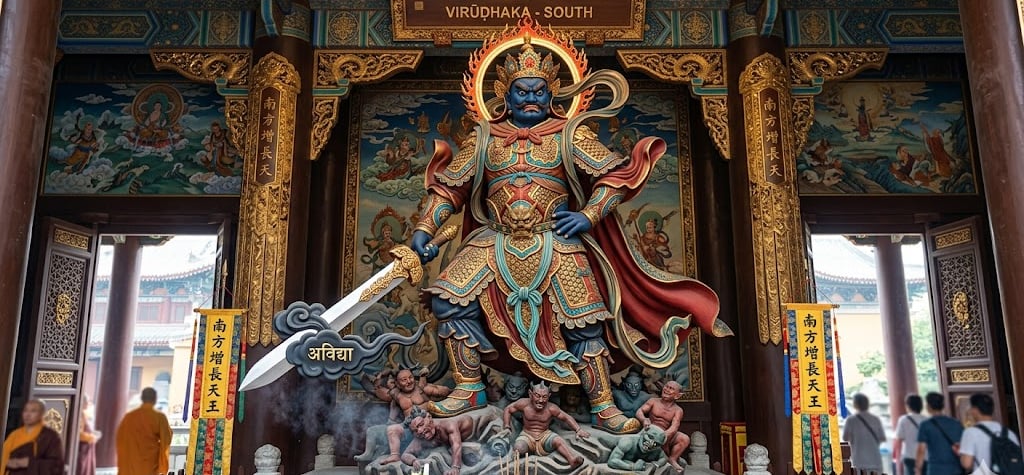
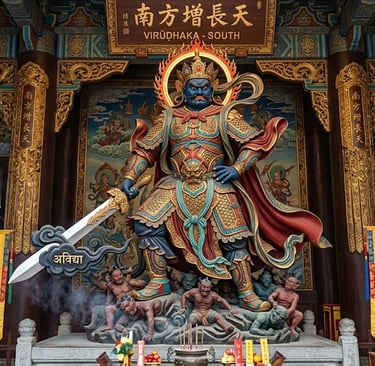
The celestial topography of Buddhist cosmology is anchored by the four cardinal directions, each overseen by a divine guardian known as a Heavenly King. These figures, residing on the slopes of Mount Meru, serve as the frontline defenders of the spiritual world and the protectors of those who seek enlightenment. Among these four formidable deities, Virūḍhaka stands as the majestic guardian of the South. His presence is characterized by a striking, deep blue complexion that reflects the vastness of the heavens and the profound depths of the spiritual journey. Known as the King of the Kumbhandas and the Pretas, Virūḍhaka is not merely a sentinel of physical space but a master of growth and a relentless harvester of delusion. His role is vital in the maintenance of cosmic order, ensuring that the seeds of virtue are nurtured while the weeds of ignorance are decisively cut away.
To understand Virūḍhaka is to understand the transformative power of spiritual discipline and the necessity of keen discernment. In traditional iconography, he is often depicted with a fierce expression, signifying the intensity required to confront the myriad distractions of the material world. His primary attribute, a massive and shimmering sword, is his most defining feature. This is not a weapon of worldly conquest or physical violence; rather, it is the Sword of Wisdom, or Prajna. This divine blade is forged from the clarity of a focused mind and is used specifically to slash through the thickets of "avidya" or fundamental ignorance. In the Buddhist tradition, ignorance is seen as the root cause of all suffering, the clouded lens through which we misperceive reality. Virūḍhaka’s duty is to help the practitioner see through the illusions of the ego, cutting the ties to worldly attachments that bind the soul to the cycle of rebirth.
The sapphire hue of Virūḍhaka’s skin is deeply symbolic, often associated with the element of space and the infinite nature of the mind. In the cycle of the Four Heavenly Kings, the South is the direction of the sun at its zenith, representing the peak of energy, growth, and the ripening of karma. Virūḍhaka's name itself translates roughly to "one who causes to grow" or "the lord of expansion." This suggests that his guardianship is not static. He does not simply stand at a gate; he actively facilitates the blossoming of a practitioner’s potential. By removing the obstacles of ignorance, he creates the necessary space for wisdom to flourish. His presence reminds us that spiritual growth is an active process that requires both the defensive posture of protecting one’s peace and the offensive action of challenging one’s own preconceived notions and biases.
In the intricate hierarchy of the spirit world, Virūḍhaka commands a host of supernatural beings, primarily the Kumbhandas. These are often described as giant-like entities who serve the King and help maintain the boundaries between the mundane and the sacred. By commanding such powerful forces, Virūḍhaka demonstrates the authority of the Dharma over the chaotic elements of the subconscious. When a practitioner invokes the protection of the Southern King, they are essentially asking for the strength to govern their own internal impulses. The fierce appearance of the King and his retinue serves as a psychological mirror, reflecting the inner strength required to face the "demons" of greed, anger, and delusion. To look upon Virūḍhaka is to be reminded that the path to peace is often paved with the rigorous work of self-correction and the sharp application of truth.
The sword held by Virūḍhaka is particularly significant when compared to the attributes of the other three kings. While his peers may hold a pagoda, a lute, or a dragon, the sword is the most direct instrument of severance. It represents the "Vajra" quality of the mind—indestructible and sharp enough to pierce through any falsehood. In many temples, Virūḍhaka is positioned at the entrance, serving as a reminder that before one can enter a state of deep meditation or sacred space, they must be willing to leave behind their heavy baggage of misconceptions. The sword hangs over the threshold of the ego, demanding a price of admission: the willingness to see things as they truly are, rather than how we wish them to be. This cutting action is an act of ultimate compassion, for it is only through the destruction of the false self that the true, enlightened nature can emerge.
Living under the gaze of Virūḍhaka means embracing the concept of "Right Effort" within the Eightfold Path. The South represents the heat of the day, the time of most intense labor. This mirrors the middle stage of the spiritual path where the initial excitement has faded and the real, often grueling work of habit-breaking begins. Virūḍhaka provides the "Blue Light" of clarity during these moments of exhaustion. When the mind becomes muddled by the complexities of modern life, the image of the King wielding his sword serves as a meditative focal point. It encourages the seeker to simplify, to prune away the unnecessary, and to focus on the core essence of their practice. He is the patron of those who are currently in the "thick of it," offering a steady hand and a sharp edge to those struggling to find their way through the fog of daily existence.
The cultural impact of Virūḍhaka extends across Asia, from the towering statues in Japan’s Todai-ji temple to the colorful murals in the monasteries of Tibet and China. In each tradition, while his name might change—becoming Zōjō-ten in Japan or Piliyakka in other regions—his essence remains constant. He is the eternal protector of the southern continent, Jambudvipa, which in Buddhist cosmology is the realm inhabited by humans. This makes his role especially intimate to our experience. He is the guardian of our world, the watcher of our specific struggles. His sword is constantly moving, reacting to the shifting tides of human thought, always ready to intervene when a sincere seeker calls out for clarity. He represents the divine promise that ignorance is not a permanent state, but a veil that can be lifted with the right tools and the right resolve.
As we reflect on the symbolism of the Blue King, we find a message of profound empowerment. Virūḍhaka does not demand worship so much as he demands awareness. He stands as a cosmic reminder that we all possess the "sword" within us—the faculty of critical thinking and spiritual discernment. By aligning ourselves with the energy of the South, we commit to the process of continuous growth and the relentless pursuit of truth. We learn that to protect our spiritual life, we must be brave enough to strike down the comforting lies we tell ourselves. Virūḍhaka, in his celestial armor and radiant blue skin, remains a timeless icon of the warrior-monk spirit, standing guard at the gates of our consciousness, waiting for us to pick up our own blades and join him in the noble task of clearing the way toward liberation.
Virūḍhaka stands as the majestic guardian of the South.
Sera Jey Wisdom Center
A Gelug Tibetan Buddhist center in Jakarta. Join our weekly prayers every Saturday at 2 PM — everyone is welcome.
Address
Sera Jey Wisdom Center
Ruko Savoy Blok C1 No.31 & 32,
River Garden Jakarta Garden City,
Cakung Timur, Jakarta Timur 13910,
Indonesia
© 2026 Sera Jey Wisdom Center Jakarta. All rights reserved.