
The Four Heavenly Kings: Dhṛtarāṣṭra (East)
Dhṛtarāṣṭra, the majestic white king of the East, is unique. Discover why he holds not a weapon, but a pipa lute, and how this simple instrument profoundly symbolizes the essential Middle Way and the protective power of inner harmony on the path to enlightenment.
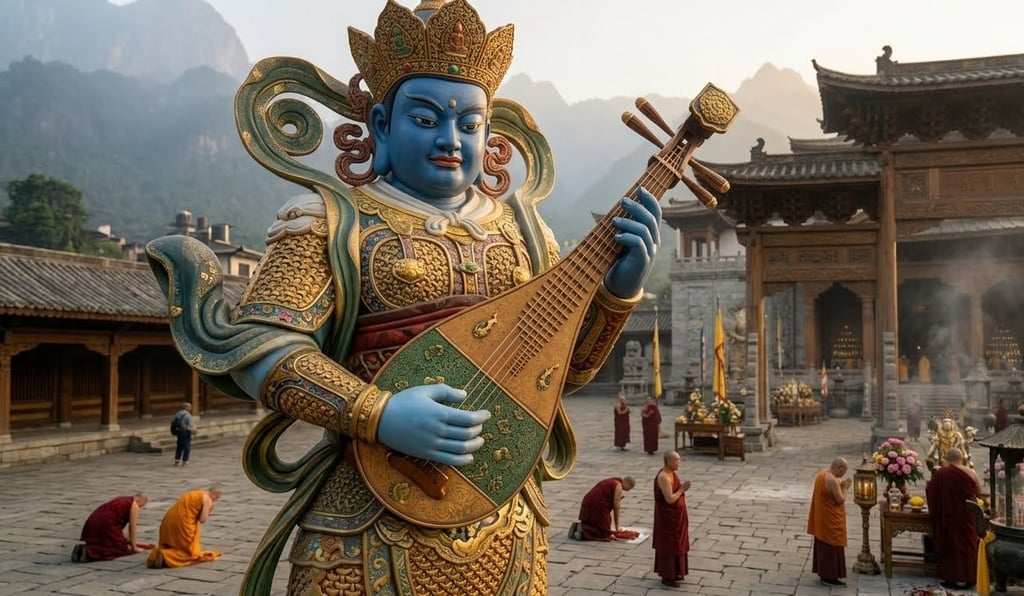
Dhrtarastra, the Heavenly King of the East
Dhṛtarāṣṭra, whose name translates from Sanskrit as "the Upholder of the Kingdom," is one of the Four Heavenly Kings (Caturmahārāja) in Buddhist cosmology.
These four majestic figures serve as the primal guardians of the world, protectors of the Dharma (Buddhist teachings), and defenders of the directionally-bound heavens under their respective domains. Residing in the Cātummahārājika heaven, located on the lower slopes of Mount Meru, the center of the Buddhist universe, they hold a critical position in celestial hierarchy. The 四大天王 (Sì Dà Tiānwáng) - as they are known in Chinese, among other regional names – are distinct from immortal gods; instead, they are elevated devas, advanced beings who have achieved their divine status through immense merit accumulated over countless lifetimes. Yet, they remain subject to the laws of karma and rebirth, continuing their own spiritual evolution even as they watch over humanity. Within this powerful group, Dhṛtarāṣṭra is meticulously assigned to the Eastern direction, where he reigns as the celestial monarch of this specific cosmic quarter and as the leader of the Gandharvas.
The Gandharvas are often referred to as celestial musicians or aerial spirits, residing in the air and characterized by their exquisite, refined energy and their connection to beauty and sound. This inherent association with music and harmony profoundly influences the identity and depiction of their king, Dhṛtarāṣṭra. As the Heavenly King of the East, Dhṛtarāṣṭra's function is centered on the restoration and maintenance of harmony. He embodies purity, virtue, and the peaceful cultivation of the spiritual path. His guardianship of the East is not portrayed through aggressive force or overt martial dominance, but rather through a subtler, yet equally potent, power of sonic resonance and moral equilibrium. This fundamental approach marks a distinct contrast to some of his counterparts who might carry more overtly intimidating weapons, and it underscores a crucial Buddhist tenet: that inner transformation and external protection can often be achieved through peaceful, resonant means.
Visually, Dhṛtarāṣṭra is easily identifiable, consistently characterized by a serene white complexion. This pure hue symbolizes the unwavering clarity of his purpose and the spotless virtue that underpins his actions. Within traditional Buddhist temple iconography across East Asia and Southeast Asia, he is typically positioned in the East hall, often as the first guardian encountered upon entering the temple complex. It is in this location that his defining attribute, the pipa, a traditional Chinese lute or stringed instrument, is always prominently displayed in his hands. He is typically seated or standing, sometimes with attendants or within an architectural setting appropriate for a celestial ruler.
The pipa lute in the hands of Dhṛtarāṣṭra is far from a simple prop or merely a musical instrument; it serves as a profound metaphysical symbol. In Buddhist doctrine, this instrument is intricately linked to the core concept of the Middle Way, which represents the essential path of wisdom and enlightenment that avoids all forms of extreme behavior, whether it be excessive self-indulgence on one hand or extreme self-mortification on the other. A classic Buddhist parable, often linked to the teachings of the historical Buddha himself, illustrates this concept perfectly through the metaphor of a stringed instrument: if the strings are tuned too tightly, they will snap and become useless; conversely, if they are tuned too loosely, they will not produce any sound. Only when they are tuned perfectly to the proper tension do they resonate with a clear and melodious sound.
This musical analogy directly mirrors the discipline required in spiritual practice. It emphasizes the critical need for continuous effort, unwavering dedication, and, most importantly, the wisdom to navigate a path of moderation. Dhṛtarāṣṭra, through the simple act of holding the pipa, becomes a living personification of this core Middle Way principle. The very sight of him reminds practitioners that extreme stances, whether in action or belief, are not sustainable or conducive to spiritual growth. Instead, it is the quiet resonance of a balanced, ethical, and mindful life that ultimately leads to true liberation.
Furthermore, Dhṛtarāṣṭra does not merely play music for entertainment in the celestial realm. The harmonious melodies he produces are considered powerful sonic vibrations capable of transforming the minds and hearts of sentient beings. When mortals or celestial beings hear the music of the Gandharva king, it is said that their anger, greed, and other negative afflictions are pacified, replaced by feelings of peace, clarity, and a natural inclination towards virtuous conduct. In this sense, his music becomes a primary tool of conversion, a compassionate method of guiding beings towards the path of Dharma not through coercion, but through the irresistible pull of beauty, order, and inner peace.
This specific role as the "Melodious Converter" emphasizes that protection of the world does not always require force or aggressive intervention. While other guardians may defend against specific external threats with swords or other weaponry, Dhṛtarāṣṭra protects by fortifying the inner world of sentient beings, rendering them less susceptible to the impulses of chaos and ignorance. His protection operates at a fundamental level, addressing the root causes of suffering by offering a model of internal stability. He reminds the spiritual seeker that maintaining balance and cultivating virtue are powerful defensive acts themselves, creating a field of peace that can effectively dispel the forces of disharmony before they manifest in harmful actions.
When a devotee or visitor enters a Buddhist temple and confronts the majestic figure of the white king of the East, they are encountering much more than just a historical or mythological depiction. They are facing a potent cosmic reminder to cultivate their own internal "strings" with wisdom and moderation. Dhṛtarāṣṭra’s presence serves as an externalization of the internal discipline required for spiritual practice. Just as he steadfastly guards the eastern quarter, the practitioner must also become an active, vigilant guardian of their own senses, ensuring that thoughts, words, and actions are consistent with the principles of harmony and moral integrity. The very posture of Dhṛtarāṣṭra, focused on his lute and generating a resonant peace, inspires the seeker to prioritize the quiet work of self-cultivation.
Ultimately, Dhṛtarāṣṭra, the Upholder of the Kingdom, stands as a timeless symbol of the power of gentle influence and the critical importance of moderation. He represents the potential for creating harmony both within oneself and in the world through the quiet, consistent cultivation of inner peace and ethical conduct. By understanding and meditating upon the symbolism embedded in his identity, his white color, his position in the East, and, above all, the resonant metaphor of his pipa lute, one gains insight into the sophisticated Buddhist understanding of protective energy and the foundational importance of the Middle Way on the profound journey toward enlightenment. In the vast architecture of Buddhist thought, the Four Heavenly Kings are not just static guardians of the celestial peaks; they are active, present guides, encouraging every sincere heart that seeks truth to walk the path of virtue, balance, and unwavering compassion. Dhṛtarāṣṭra ensures that as long as beings strive for inner harmony, they will be supported and protected on their spiritual journey.
Sera Jey Wisdom Center
A Gelug Tibetan Buddhist center in Jakarta. Join our weekly prayers every Saturday at 2 PM — everyone is welcome.
Address
Sera Jey Wisdom Center
Ruko Savoy Blok C1 No.31 & 32,
River Garden Jakarta Garden City,
Cakung Timur, Jakarta Timur 13910,
Indonesia
© 2026 Sera Jey Wisdom Center Jakarta. All rights reserved.