
The Fierce Protectors: Why Some "Gods" Look Scary
Uncover the profound meaning behind Buddhism's most intimidating icons. This post explores why "Wrathful Deities" like Mahakala use terrifying imagery, skulls, flames, and weapons not to frighten us, but as a form of "sacred rage" designed to destroy ego and liberate us from our most stubborn habits. Learn how these fierce protectors represent the ultimate expression of tough love and the intense energy required for true spiritual transformation.
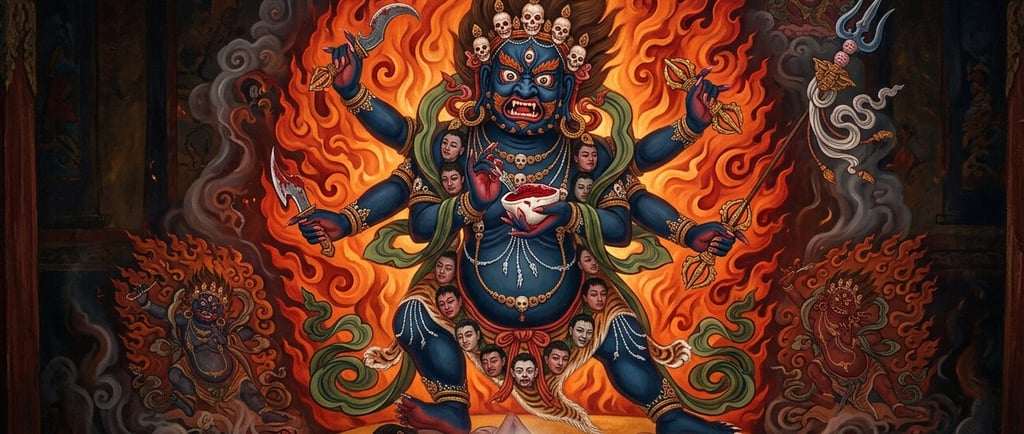
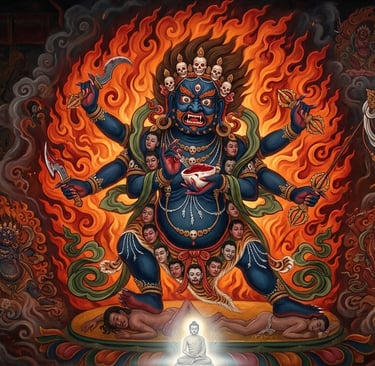
Entering a traditional Tibetan Buddhist temple for the first time can be an experience that oscillates between profound serenity and sudden, visceral shock. While one wall might feature the golden, tranquil face of a meditating Buddha, the next may be dominated by a towering figure draped in tiger skins, crowned with human skulls, and wreathed in roaring crimson flames.
These figures, known as Wrathful Deities, often brandish curved knives or thunderbolts, their eyes bulging and their mouths agape in a terrifying snarl. To the uninitiated Western eye, these images might suggest demons or dark spirits meant to inspire fear or demand appeasement. However, within the logic of the Dharma, these "scary gods" are not villains or monsters. They are, in fact, the most radical expressions of compassion. They represent the "fierce protectors" of our own spiritual potential, embodying the intense, uncompromising energy required to shatter the illusions of the ego and the suffocating grip of ignorance.
To understand why a path centered on peace and non-violence would utilize such aggressive imagery, we must first look at the nature of the obstacles we face in our daily lives. Enlightenment is often discussed in soft, poetic terms like a lotus flower blooming in a quiet pond. While that imagery captures the result, it rarely captures the grit of the process. Our deep-seated habits, our addictions to anger, and our reflexive clinging to a false sense of self are not polite guests that leave when asked nicely. They are entrenched, calcified structures of the mind that have been reinforced over a lifetime, or according to Buddhist thought, many lifetimes. Sometimes, the gentle whisper of mindfulness is not enough to wake us up from a destructive trance. We need a shout. We need the "sacred rage" of a protector like Mahakala to provide the jolting energy necessary to break through the thickest walls of our psychological resistance.
The Wrathful Deities are essentially "tough love" personified on a cosmic scale. Think of a parent who sees their child about to run into a busy street. In that moment, the parent does not speak in a soft, meditative monotone; they shout with a terrifying intensity and perhaps even grab the child’s arm with a force that might leave a bruise. To an observer who doesn't see the oncoming car, the parent looks violent and angry. But to anyone who understands the context, that "wrath" is the purest form of love and protection. The deities function in the exact same way. They are the enlightened mind taking on a terrifying form to save us from the "oncoming traffic" of our own self-destruction. Their scary appearance is a reflection of the seriousness of the situation. They aren't trying to scare us into submission; they are trying to scare us into awareness.
The specific symbolism found on these figures further clarifies their benevolent intent. Take, for example, the crown of five skulls often worn by Mahakala or Yamantaka. In a secular context, skulls represent death and morbidity. In the context of the fierce protectors, these skulls represent the "transmutation" of the five poisons: anger, desire, ignorance, pride, and jealousy. By wearing them as jewelry, the deity signals that these toxic emotions have been conquered and turned into the five wisdoms. The flames that surround these figures are not the fires of a hellish punishment, but the fire of "Prajna," or primordial wisdom. This is a fire that consumes everything false and leaves behind only what is true. When we see a deity dancing in flames, we are seeing the active process of purification. The fire is hot because transformation is difficult, and the ego finds the heat of truth to be agonizing.
The "sacred rage" of these protectors is specifically directed at the ego, the "I" that we protect so fiercely yet which causes us so much suffering. The ego is a master of disguise; it can even co-opt spirituality to make itself feel more special and superior. It can turn meditation into a vanity project or kindness into a performance. The Wrathful Deities are the only forces capable of outsmarting this "spiritual materialism." Their ferocity is a specialized tool designed to cut through the ego’s endless excuses and justifications. When Mahakala brandishes a flaying knife, he is not threatening a person; he is symbolically skinning the "ego-self" to reveal the raw, luminous reality underneath. He represents the uncompromising boundary where we must stop lying to ourselves. He is the guardian of the threshold, ensuring that no pretension or hypocrisy follows us into the deeper states of realization.
This concept of "fierce energy" is also a recognition that anger is a powerful force that shouldn't always be suppressed. In many spiritual traditions, there is a tendency to view all "negative" emotions as things to be buried or ignored. Buddhism, particularly in its Vajrayana or Tantric forms, takes a more pragmatic approach. It suggests that the energy behind anger is actually clarity and power, it's just being misdirected. By meditating on a Wrathful Deity, a practitioner learns to "harness" that heat. Instead of letting anger turn into a destructive external force that hurts others, it is turned inward to act as a laser-focused drill, boring through the density of one's own ignorance. The deity teaches us how to be "fierce" without being "hateful." It is possible to be absolutely uncompromising with one's own shadow while remaining deeply compassionate toward all living beings.
For the newcomer, it is helpful to realize that these figures are often described as "emanations" of the more peaceful Buddhas. For example, the terrifying Mahakala is considered a wrathful form of Avalokiteshvara, the Buddha of Infinite Compassion. This means that the terrifying face and the peaceful face are actually two sides of the same coin. When we are open and receptive, compassion looks like a gentle smile. When we are stubborn, closed-off, and caught in the grip of harmful patterns, that same compassion must take on a fierce form to reach us. It is the same medicine, just delivered in a different dosage. The "scary" look is a skillful means tailored to the specific needs of a mind that is currently "stuck."
Furthermore, these deities serve as a psychological mirror. If we look at an image of a fierce protector and feel a sense of intense fear or repulsion, it is often because that figure is threatening the parts of us we aren't ready to let go of. We fear the "destroyer" because we are still identifying with the things that need to be destroyed—our pride, our grudges, and our illusions. As a practitioner matures, their relationship with these figures changes. The image that once felt threatening begins to feel like a powerful ally. There is a profound sense of relief in knowing that there is a part of the enlightened mind that is "stronger" than our neurosis. It is like having a bodyguard for your soul; when the darkness of depression or the chaos of obsessive thought begins to close in, the fierce protector stands in the gap, reminding us that the light of awareness cannot be extinguished.
Ultimately, the Wrathful Deities teach us about the totality of human experience. A spirituality that only embraces the "light and fluffy" is a spirituality that cannot survive the real-world grit of loss, betrayal, and death. By including the fierce and the terrifying within the sacred, Buddhism provides a path that is robust enough for the darkest nights of the soul. These "scary gods" remind us that we don't need to be afraid of our own intensity. We just need to learn how to direct it. When we stop seeing them as external monsters and start seeing them as the fierce energy of our own wisdom, we gain access to an unstoppable power. We realize that the flames aren't there to burn us; they are there to light the way, and the skulls aren't a sign of death, but a celebration of the end of the delusions that kept us from truly living. The next time you see a figure like Mahakala, don't look away in fear. Look closer, and you might just see the fiercest friend you've ever had, standing ready to help you burn away everything that isn't truly you.
Sera Jey Wisdom Center
A Gelug Tibetan Buddhist center in Jakarta. Join our weekly prayers every Saturday at 2 PM — everyone is welcome.
Address
Sera Jey Wisdom Center
Ruko Savoy Blok C1 No.31 & 32,
River Garden Jakarta Garden City,
Cakung Timur, Jakarta Timur 13910,
Indonesia
© 2026 Sera Jey Wisdom Center Jakarta. All rights reserved.