
The Bodhisattva of Great Compassion (Mahākaruṇā)
Explore the essence of Avalokiteśvara, the most revered Bodhisattva of Compassion. Discover his vow to save all beings, his diverse forms across Asia (like the female Guanyin), and the power of his sacred mantra, "Oṃ Maṇi Padme Hūṃ," which embodies his universal, watchful mercy. This figure is the ultimate symbol of selfless aid and boundless love in Mahāyāna Buddhism.
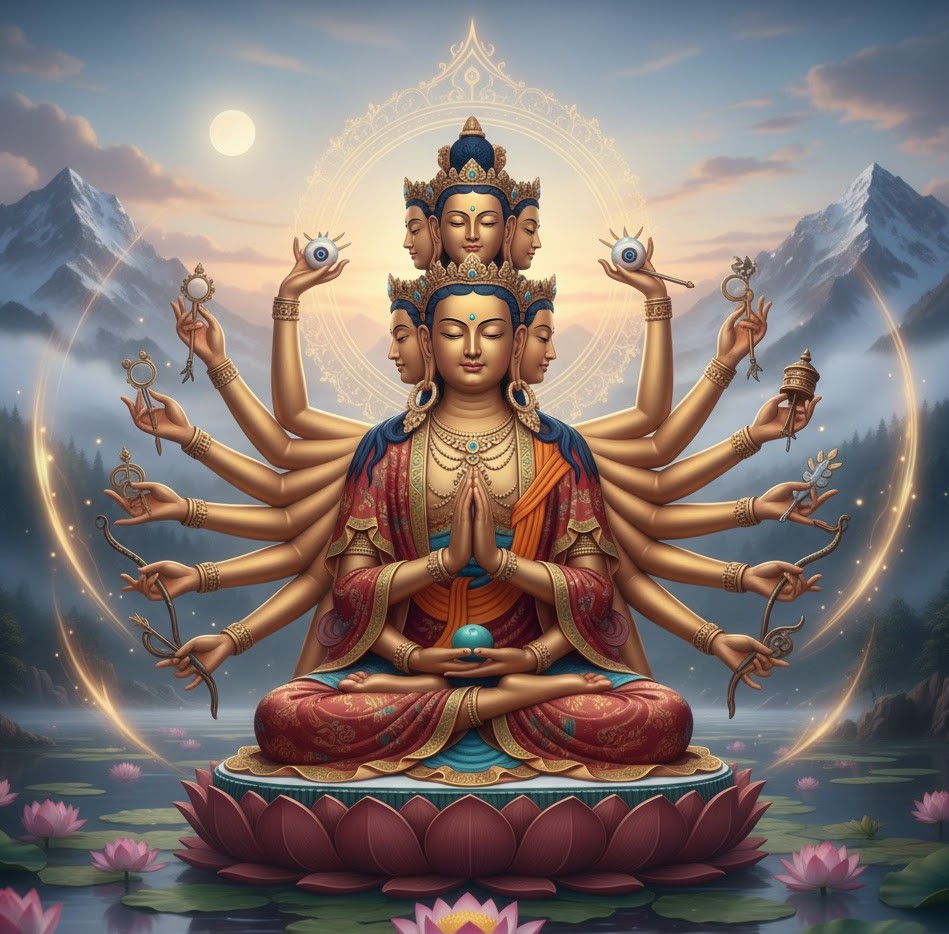
Avalokiteśvara, the Bodhisattva of Great Compassion (Mahākaruṇā), holds a position of immense and central importance within the Mahāyāna tradition of Buddhism, symbolizing the ideal of selfless, active compassion that is essential for achieving enlightenment.
His spiritual significance stems from his foundational vow, a profound commitment to postpone his own entry into Nirvana until every single sentient being is liberated from the pain and delusion of the cycle of existence (samsara). This unwavering dedication makes him the perfect embodiment of the bodhisattva path, which prioritizes the welfare of others over personal salvation. His name, often interpreted as "The Lord Who Looks Down" or "The One Who Hears the Cries of the World," confirms his omnipresent awareness of suffering.
This awareness is not passive; it drives his continuous, active engagement with the world. Avalokiteśvara manifests in countless forms across different cultures as Chenrezig in Tibet and the feminine Guanyin in East Asia to ensure his accessibility to all who are in distress, adapting his appearance to best suit the needs and understanding of those he seeks to help. When practitioners pray to him, this is not an appeal for divine intervention in the common sense, but a practice of connection and spiritual transmission. What he "does" when someone prays is not to magically fix external problems, but rather to instantaneously respond with a pure, concentrated energy of compassion and wisdom.
Through the power of his vow and accumulated merit, he serves as a catalyst for inner transformation. Prayer, especially the recitation of his six-syllable mantra, "Oṃ Maṇi Padme Hūṃ," helps the devotee to purify negative karma, open their own heart to compassion, and develop the wisdom needed to face their struggles. By focusing on his image or mantra, the practitioner invokes the potential for great compassion that already exists within them, allowing Avalokiteśvara's exemplary conduct to serve as a mirror and guide for their own ethical and spiritual development, effectively helping them to help themselves and others.
Sera Jey Wisdom Center
A Gelug Tibetan Buddhist center in Jakarta. Join our weekly prayers every Saturday at 2 PM — everyone is welcome.
Address
Sera Jey Wisdom Center
Ruko Savoy Blok C1 No.31 & 32,
River Garden Jakarta Garden City,
Cakung Timur, Jakarta Timur 13910,
Indonesia
© 2026 Sera Jey Wisdom Center Jakarta. All rights reserved.