
The Architect of the Cosmos: Brahma’s Role and Contribution to Buddhism
Discover how Buddhism "reimagined" the creator god. This post explores the paradoxical role of Brahma, not as an omnipotent ruler, but as a celestial student and the compassionate figure who persuaded the Buddha to share his wisdom with the world.
In the popular imagination, the lines between Hinduism and Buddhism are often blurred, leading many to assume that the gods of one are simply imported or rejected by the other.
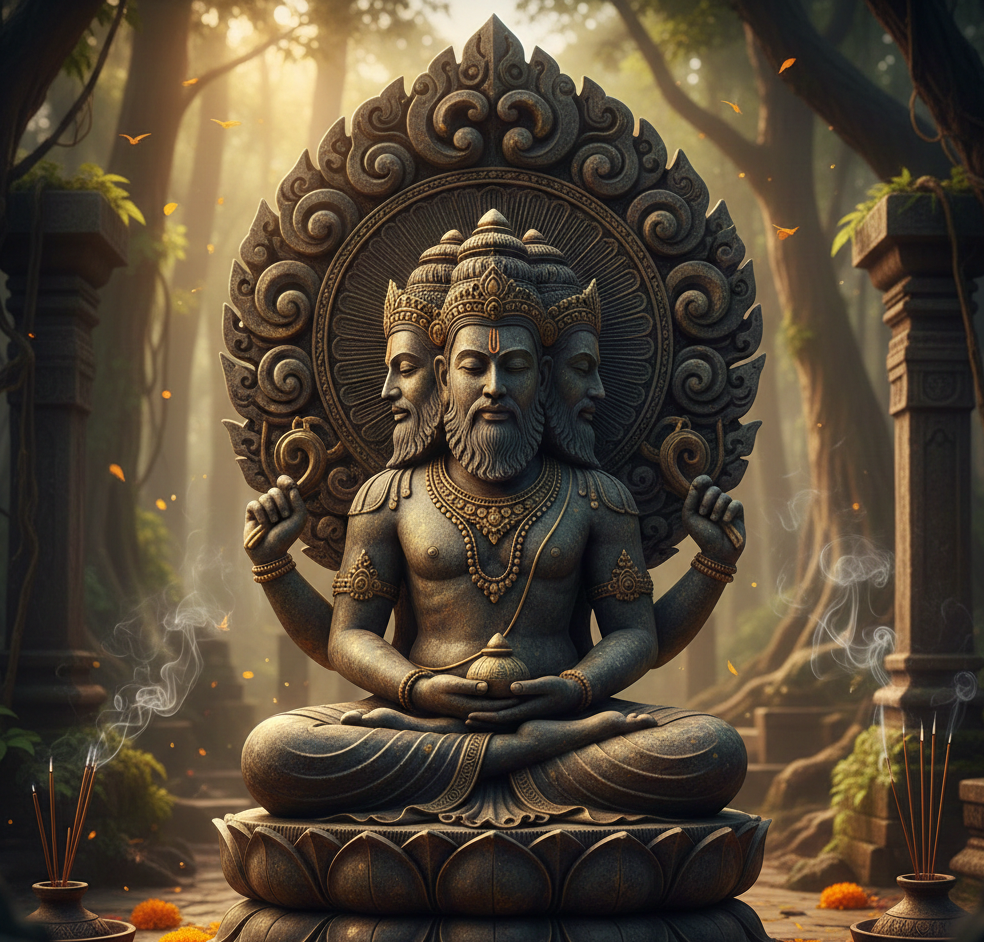
However, the figure of Brahma, the creator god of the Brahmanical tradition occupies a unique, paradoxical, and essential position within the Buddhist cosmos.
While Buddhism famously rejects the notion of an omnipotent, eternal "Creator" ($Ishvara$), it does not deny the existence of Brahma. Instead, Buddhism "re-imagines" him. In the Pali Canon and Mahayana sutras, Brahma is not the source of the universe, but its most senior inhabitant, a figure of great virtue who, despite his immense power, is still subject to the laws of karma and rebirth.
The Buddhist Cosmology: Positioning the Great Brahma
To understand Brahma’s contribution, we must first look at where he sits in the Buddhist "Map of Existence." In Buddhist cosmology, the universe is divided into three realms: the Realm of Desire (Kamadhatu), the Realm of Form (Rupadhatu), and the Formless Realm (Arupyadhatu).
Brahma resides in the Rupadhatu, specifically in the "Brahma-loka" (Brahma worlds). These are planes of existence characterized by intense meditative bliss and radiant light.
Unlike the gods of the Desire Realm (like Indra), the Brahmas are free from sensual passion. They are beings of pure light and mental energy. However, Buddhism introduces a witty theological critique: the "Great Brahma" (Maha Brahma) believes himself to be the creator simply because he was the first to be reborn at the beginning of a new cosmic cycle. Finding himself alone, he wished for company; when other beings eventually appeared due to their own karma, he mistakenly concluded, "I created them."
Brahma’s Greatest Contribution: The Invitation to Teach
Perhaps the most pivotal moment in Buddhist history involving Brahma is the Ayacana Sutta. According to tradition, immediately after Siddhartha Gautama attained Enlightenment under the Bodhi tree, he hesitated.
The Buddha saw that the truth he had discovered Pratityasamutpada (Dependent Origination) and Nirvana was "profound, difficult to see, and difficult to understand." He looked at a world blinded by greed and hatred and considered remaining in silent forest-dwelling, choosing not to teach.
It was Brahma Sahampati, the most senior of the Brahmas, who descended from the heavens to intervene. He knelt before the Buddha and pleaded:
"Lord, let the Blessed One teach the Dhamma! Let the Sublime One teach the Dhamma! There are beings with but little dust in their eyes who are perishing through not hearing the Dhamma."
Why this matters:
Validation of the Dhamma: By having the highest deity of the contemporary religion bow to the Buddha, the texts establish that the Buddha’s wisdom surpasses even the "Creator."
The Bridge to Humanity: Brahma represents the "compassionate urge." His intervention ensures that Buddhism becomes a world religion rather than a private realization.
Legitimacy: For a 5th-century BCE Indian audience, if Brahma, the ultimate authority, recognized the Buddha, then the Buddha was worth listening to.
The "Brahma-Viharas": The Divine Abodes
Brahma’s name is permanently etched into Buddhist practice through the Brahma-Viharas, translated as the "Divine Abodes" or "Four Immeasurables." These are the four highest mental states that a practitioner can cultivate.
The term "Brahma-Vihara" literally means "Living like Brahma." In the Buddhist context, this is a masterful piece of rebranding. The Buddha taught that one does not reach Brahma through animal sacrifice or Vedic hymns, but by radiating four specific qualities to all corners of the universe:
Metta (Loving-kindness): The wish for all beings to be happy.
Karuna (Compassion): The desire to remove the suffering of others.
Mudita (Sympathetic Joy): Rejoicing in the success and happiness of others.
Upekkha (Equanimity): Maintaining a stable mind amidst the "eight worldly winds" (praise/blame, gain/loss, etc.).
By practicing these, a human being becomes "equal to Brahma" in spirit. This contribution shifted the focus from external ritual to internal psychological transformation.
Brahma as a Protector and Attendant
In various Sutras, Brahma (often alongside Sakka/Indra) acts as a celestial attendant to the Buddha. He appears at major life events: the Buddha’s birth, his first sermon, and his final passing (Parinirvana).
In the Mahasamaya Sutta, Brahma leads a vast host of celestial beings to pay homage to the Sangha. This serves a pedagogical purpose: it shows that even the most powerful entities in the universe are "students" of the Dhamma. It deconstructs the ego of the practitioner if even a Great Brahma is humble enough to seek the Truth, so should we.
Brahma in Mahayana and Vajrayana Buddhism
As Buddhism spread into East Asia and Tibet, the role of Brahma evolved but remained significant. In Mahayana traditions, Brahma is often seen as a Dharmapala (Protector of the Dharma).
In China and Japan: Brahma is known as Bonten. He is often depicted in art holding a lotus and a sutra, symbolizing the union of worldly power and spiritual wisdom.
In Thailand: The cult of "Phra Phrom" (the Thai representation of Brahma) is immensely popular. The famous Erawan Shrine in Bangkok demonstrates how Buddhist practitioners still revere Brahma as a deity who can grant worldly blessings, provided those blessings help one stay on the path of merit.
Conclusion: A God Reborn in Wisdom
Brahma’s presence in Buddhism is a masterclass in religious synthesis. The Buddha did not "kill" the old gods; he gave them a new job. By stripping Brahma of his status as an eternal creator and repositioning him as a virtuous, yet mortal, seeker of truth, Buddhism successfully integrated the cultural landscape of India while maintaining its core philosophy of impermanence (Anicca).
Brahma reminds the Buddhist practitioner that even the highest states of heavenly existence are not the end of the road. Even a god must eventually listen to the Dhamma to find true liberation. In this sense, Brahma’s greatest contribution was his humility, the recognition that the light of a Buddha shines brighter than the light of a thousand heavens.
Sera Jey Wisdom Center
A Gelug Tibetan Buddhist center in Jakarta. Join our weekly prayers every Saturday at 2 PM — everyone is welcome.
Address
Sera Jey Wisdom Center
Ruko Savoy Blok C1 No.31 & 32,
River Garden Jakarta Garden City,
Cakung Timur, Jakarta Timur 13910,
Indonesia
© 2026 Sera Jey Wisdom Center Jakarta. All rights reserved.