
The 4 Major Lineages Demystified
Discover the unique histories, meditative practices, and philosophical highlights of the four primary lineages of Tibetan Buddhism Nyingma, Kagyu, Sakya, and Gelug and learn how these diverse traditions offer tailored paths leading to the same ultimate peak of freedom and boundless compassion.
6/1/20265 min read
To the uninitiated, entering the world of Tibetan Buddhism can feel like walking into a brilliant but overwhelming labyrinth of complex deities, vibrant tapestries, and deeply layered rituals.
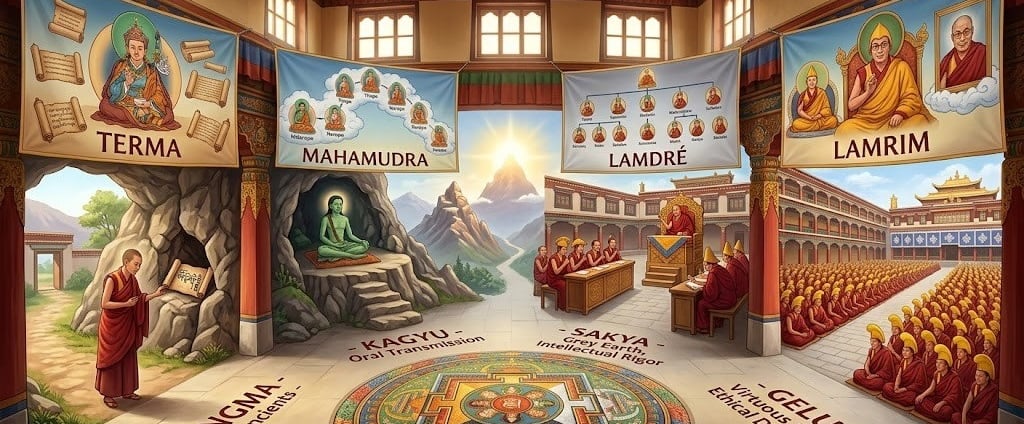
This rich spiritual landscape is not a single monolithic entity, but a dynamic tapestry woven from four primary historical threads, each known as a lineage or school. While all four schools share the foundational core of Buddhist philosophy such as the pursuit of liberation for all beings and the realization of emptinessthey differ beautifully in their historical origins, specific meditative techniques, and lineage masters. Demystifying these four distinct traditions—the Nyingma, Kagyu, Sakya, and Gelug is the essential first step toward appreciating the vast depth of Himalayan spirituality, transforming a confusing maze of rituals into a clear map of diverse paths leading to the exact same mountain peak.
The journey begins with the Nyingma tradition, affectionately and historically known as the school of the Ancients. Founded in the eighth century during the first dissemination of Buddhism into Tibet, the Nyingma lineage traces its roots directly back to Padmasambhava, the legendary Indian tantric master universally revered by Tibetans as Guru Rinpoche. Because it is the oldest school, Nyingma preserves the earliest translations of Buddhist texts and possesses a unique administrative structure, famously maintaining a strong tradition of non-monastic, married practitioners and yogis alongside its monastic centers. The defining jewel of the Nyingma school is its fascinating system of terma, or hidden treasures. Recognizing that the people of the eighth century were not yet spiritually mature enough to comprehend certain advanced teachings, Guru Rinpoche and his closest disciples hid elements of wisdom deep within the Tibetan landscape hiding them inside caves, rocks, lakes, and even within the very consciousness of future masters. Over the centuries, specially gifted spiritual treasure-revealers, known as tertöns, have discovered these texts and physical artifacts precisely when the world needed them most, ensuring that the Nyingma teachings remain dynamically fresh, relevant, and directly tailored to the psychological challenges of each shifting era. At the absolute apex of the Nyingma philosophical system sits Dzogchen, the Great Perfection, a radical meditative practice aimed at directly recognizing the natural, primordial purity of the mind without the need for complex visualizations or intellectual manipulation.
As the centuries rolled on, a second wave of translation and spiritual renewal swept across Tibet, giving birth to the Kagyu school, often called the Lineage of Oral Transmission. Established in the eleventh century, the Kagyu tradition places a supreme emphasis on the unbroken, experiential transmission of realization directly from the heart of the master to the heart of the student. The lineage relies heavily on a lineage of fierce, uncompromising yogis who were less concerned with academic degrees and deeply invested in the raw, lived experience of meditation. The foundation of the school was laid by the Indian masters Tilopa and Naropa, whose advanced somatic and energetic practices were brought across the Himalayas by Marpa the Translator. Marpa’s chief disciple was Milarepa, the beloved, hermit poet of Tibet who achieved full enlightenment in a single lifetime through sheer devotion and intense asceticism in mountain caves. This emphasis on intense, direct practice continues to define the Kagyu school today, which is currently guided by the Karmapa. Rather than relying solely on philosophical debate, Kagyu practitioners focus heavily on Mahamudra, the Great Seal, a profound meditation system that trains the mind to rest naturally in its own luminous clarity, alongside the Six Dharmas of Naropa, a suite of advanced yogic practices that utilize the subtle energies, heat, and dream states of the physical body to accelerate spiritual awakening.
Coinciding with this medieval spiritual renaissance was the emergence of the Sakya tradition, frequently referred to as the school of the Gray Earth due to the unique color of the soil surrounding its founding monastery in southern Tibet. Established in the eleventh century by the noble Khön family, the Sakya school is distinct in its administrative structure, as its leadership is traditionally hereditary, passed down from family members rather than through the recognition of reincarnated children. The Sakya tradition became renowned throughout Asia for its unparalleled academic rigor and intellectual brilliance, producing some of Tibet’s greatest scholars, including the famous Sakya Pandita, whose wisdom was so profound that it converted the powerful Mongol emperors to Buddhism, granting the Sakya sect political leadership over Tibet for a century. Philosophically, the Sakya lineage is anchored by a comprehensive system known as Lamdré, which translates literally to the Path and its Fruit. This elegant teaching asserts that the path to enlightenment and the final result of enlightenment are not two separate things, but are fundamentally unified within the present moment. The Sakya approach elegantly balances the intellect and the heart, requiring practitioners to undergo exhaustive studies of classical texts and logic while simultaneously engaging in deep, precise tantric visualizations, cultivating a highly disciplined mind that treats intellectual clarity as a vital stepping stone toward mystical realization.
The final major school to emerge on the Tibetan plateau was the Gelug tradition, known historically as the Virtuous Method or the Yellow Hat school. Founded in the early fifteenth century by the brilliant monastic reformer Je Tsongkhapa, the Gelug school arose as a direct response to what Tsongkhapa perceived as a decline in monastic discipline and an over-emphasis on esoteric practices across the region. Tsongkhapa sought to create a synthesis of all the existing traditions, placing a massive, foundational emphasis on strict monastic vows, ethical purity, and exhaustive logical debate. He believed that a student must develop a flawless, intellectually sound understanding of emptiness and Buddhist philosophy before attempting advanced tantric meditation, lest they fall into delusion. The Gelug school grew at an astonishing rate, constructing massive monastic universities that housed tens of thousands of monks dedicated to rigorous academic study. It is to this strict, highly organized Gelug lineage that the global spiritual icon, the Dalai Lama, belongs. Through centuries of history, the Dalai Lamas became not only the spiritual leaders of the Gelug school but also the temporal leaders of a unified Tibet, projecting the Gelug emphasis on ethics, education, and compassion onto the world stage. The core of Gelug practice centers around the Lamrim, or the Graduated Path to Enlightenment, a step-by-step psychological framework that systematically guides a student from the basic motivations of a beginner all the way to the boundless, altruistic realization of a Buddha.
When we step back and view these four schools in unison, we see that their differences are not contradictions, but a beautiful manifestation of skillful means, designed to accommodate the vastly different personalities and dispositions of human beings. For the individual who connects deeply with nature, mystery, and the spontaneous discovery of hidden wisdom, the Nyingma school opens its doors. For the practitioner who possesses an intense, passionate drive for solitary meditation and a deep emotional connection to a lineage of yogic masters, the Kagyu tradition provides the perfect laboratory. For the intellectual seeker who demands rigorous logical consistency and a flawless balance of study and ritual, the Sakya lineage offers an immaculate home. And for those who thrive within structured environments, ethical discipline, and a step-by-step, highly organized path toward the altruistic ideal, the Gelug school stands ready. By looking past the surface variations in hats, colors, and administrative structures, we discover that all four lineages are operating a single, grand spiritual architecture, utilizing different entryways to lead every unique traveler into the same spacious room of ultimate freedom and boundless compassion.
Community
Explore teachings, prayers, and cultural events.
Address
Sera Jey Wisdom Center
Ruko Savoy Blok C1 No.31 & 32,
River Garden Jakarta Garden City,
Cakung Timur, Jakarta Timur 13910,
Indonesia
+62 813 2488 4241
© 2025. All rights reserved.