
The 10 Principle Disciples of Buddha
Explore the lives of The Ten Principal Disciples, the brilliant collaborators who stood beside the Buddha, transforming a philosophical breakthrough into a universal spiritual force. This article delves into the unique mastery of figures like Sariputra in wisdom, Ananda in memory, and Mahakasyapa in discipline, explaining why their diverse contributions were essential for codifying the Dharma and ensuring its survival for two millennia. By examining their roles as the original custodians and interpretors of the path, we discover why this "First Sangha" provides a living blueprint for the varied paths to liberation today.
5/11/20264 min read
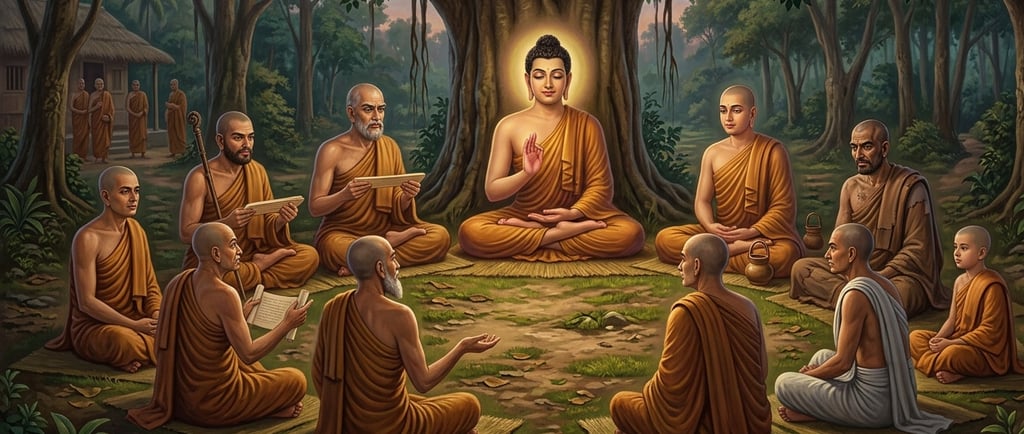
The story of the Buddha is often told as a solitary journey toward enlightenment under the Bodhi tree, but the subsequent forty-five years of his life were defined by community and the cultivation of an extraordinarily diverse group of followers.
Foremost among them were the Ten Principal Disciples, whose lives and unique mastery of specific aspects of the Dharma were essential to the establishment and survival of the Sangha. These individuals were not merely passive recipients of the Buddha’s wisdom; they were active, brilliant, and committed collaborators who ensured that the "Wheel of Dharma," once set in motion, would continue to turn long after its founder had passed into Parinirvana. Their collective significance lies in their ability to embody the diverse potential of the human mind and to provide living blueprints for the various paths within the one great way. They were the original custodians, interpretors, and exemplars of the Buddhist path, transforming a localized philosophical movement into a universal tradition.
The two most prominent figures, known as the Buddha’s chief male disciples, were Sariputra and Moggallana. Their bond, forged in childhood and unified by their search for truth, symbolized the fundamental pillars of the Buddhist path: wisdom and spiritual vitality. Sariputra, known as "Foremost in Wisdom," possessed an analytical capability that was second only to the Buddha himself. He was the architect of many doctrinal frameworks, famously elaborating on the detailed workings of the Abhidharma, or Buddhist psychology. His profound understanding allowed him to cut through intellectual confusion and lead thousands to the first stage of enlightenment.Moggallana, his counterpart, was known as "Foremost in Supernatural Powers." He did not use these abilities for spectacle but as "skillful means" to benefit others. His clairvoyance enabled him to understand the past and future karmic repercussions of others' actions, helping them to refine their conduct. His ability to access other realms, including the hell realms to help his own mother, demonstrated the potential for deep meditative concentration to overcome the limitations of the physical world. Together, they exemplified the crucial balance of understanding (prajna) and energy (virya) required for liberation.
The enduring structural integrity of the Sangha was ensured by disciples like Mahakasyapa and Upali. Mahakasyapa, the "Foremost in Ascetic Practices," embodied the strict dedication and simplification of life required of a monastical community. He despised worldly pleasure and lived with a rigorous simplicity that earned him the profound respect of the Buddha. Crucially, after the Buddha's passing, it was Mahakasyapa who convened and led the First Buddhist Council, where the Buddha's teachings were compiled, preventing the Dharma from splintering. Upali, who was a barber of the lowest caste before joining, became the "Foremost in Observing Precepts." His position demonstrated the radical inclusivity of the early Sangha, where caste was irrelevant. His painstaking recall of the monastic code (Vinaya) at the First Council became the foundation of the monastic law that governs the Sangha today, ensuring its ethical discipline.
The human dimension of the Buddha’s life and the profound intellectual depth of his teachings were preserved by Ananda, the "Foremost in Hearing," and Subhuti, the "Foremost in Understanding Emptiness." Ananda, the Buddha's cousin and personal attendant for twenty-five years, was known for his astonishing memory. Having heard more of the Buddha’s sermons than any other person, his recitation of the Sutras at the First Council provided the canonical core of the Buddhist scriptures. His gentle nature and unwavering service made him a bridge between the Buddha and the lay community. Subhuti represented the profound philosophical reach of the Dharma. He is famously central to the Heart Sutra and other Prajnaparamita (Perfection of Wisdom) texts, which explore the ultimate reality of Emptiness. His mastery of this core concept allowed the Sangha to move beyond a simplified understanding of suffering into a direct perception of the nature of existence.
Other disciples focused on the active dissemination of the Dharma. Purna was the "Foremost in Preaching." His enthusiasm and eloquence were unparalleled, allowing him to plant the "seeds of the Buddha" in the hearts of thousands. Unlike some who focused on self-cultivation, Purna was tireless in his mission to serve the public and ensure the future of the tradition. Katyayana was the "Foremost in Explaining the Doctrine." While Purna was an eloquent preacher, Katyayana was the master of exegesis, skilled at taking the Buddha's often concise or complex teachings and breaking them down for varied audiences. He had a natural ability to grasp the "best lectures" and make them accessible, ensuring the Dharma was understandable. Their significance lies in their role as the primary communicators, responsible for expanding the community’s reach across different strata of ancient Indian society.
Finally, the examples of Anuradha and Rahula provided lessons on insight and esoteric dedication. Anuradha, a cousin of the Buddha, was "Foremost in Clairvoyance" or "Divine Insight." After losing his physical sight due to an ascetic vow of sleeplessness, he developed an internal, spiritual eye that allowed him to see the truth. This transformation symbolized that true vision is not dependent on physical senses. Rahula, the Buddha's only son before his renunciation, became the "First Novice Monk." Raised by Sariputra as his preceptor, Rahula was "Foremost in Esoteric Practices." His life of refined internal practice, often done away from public view, emphasized that while some teach, others must focus purely on the deep inner refinement of the mind. He showed that the blood relation to the Buddha gave no advantage; true kinship was found only through diligent practice.
The significance of the Ten Principal Disciples transcends their historical roles. They matter because they collectively create a composite portrait of enlightenment. Each one demonstrated that the human mind has many dimensions, and the path to liberation can accommodate varied personalities and strengths. Their inclusion alongside the Buddha in statues and paintings is not a mark of worship but a celebration of the community effort that allowed the Dharma to take root. They served as mirrors for generations of practitioners, showing that whether one is inclined toward wisdom, ethics, energy, patience, or study, there is a prominent example within the founding circle to follow. They prove that the Dharma is not a solitary philosophy but a living, vibrant, and multifaceted path that thrives on collaboration and deep, committed friendship.
Community
Explore teachings, prayers, and cultural events.
Address
Sera Jey Wisdom Center
Ruko Savoy Blok C1 No.31 & 32,
River Garden Jakarta Garden City,
Cakung Timur, Jakarta Timur 13910,
Indonesia
+62 813 2488 4241
© 2025. All rights reserved.