
Saraswati: The Intersection of Hinduism and Buddhism
Explore the graceful journey of Saraswati as she flows from Hindu tradition into the heart of Buddhism. This post delves into her role as the "Buddhist Muse," revealing how the pursuit of art, music, and eloquence serves as a powerful spiritual discipline. Discover how "Right Expression" transforms creativity into a path of self-realization, proving that the act of making beauty is a direct bridge to the enlightened mind.
The fluid nature of ancient Eastern spirituality often surprises modern observers who are accustomed to rigid, walled-off religious identities. Nowhere is this cross-pollination more elegant or enduring than in the figure of Saraswati. Born from the Vedic traditions of India as a river goddess and the consort of Brahma, she eventually flowed across the conceptual borders of Hinduism and into the heart of the Buddhist pantheon. In both traditions, she remains the undisputed patron of arts, music, wisdom, and eloquence.
However, her presence in Buddhism adds a unique layer of meaning to the creative process, transforming the act of artistic expression into a rigorous spiritual discipline. She is not merely a goddess to be worshipped for a successful performance or a passing grade; she is the "Buddhist Muse," an embodiment of the idea that creativity, when directed by intention, serves as a direct path toward self-realization and the dismantling of the ego.
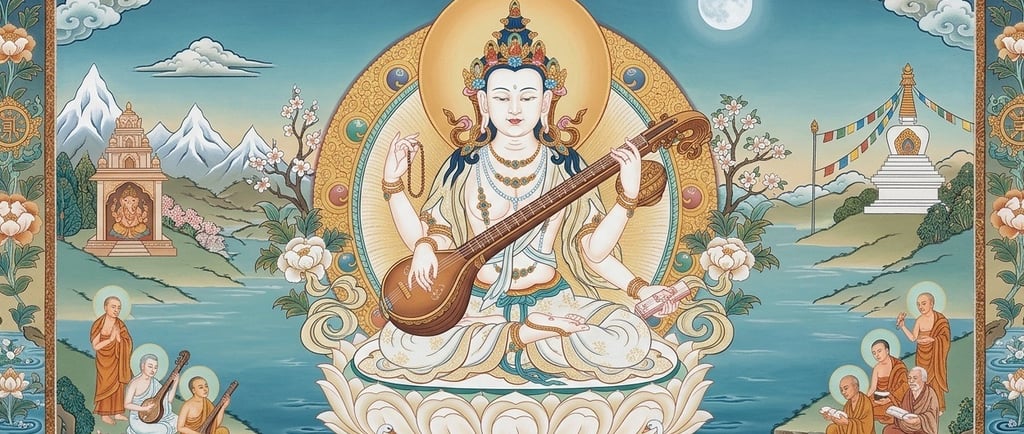
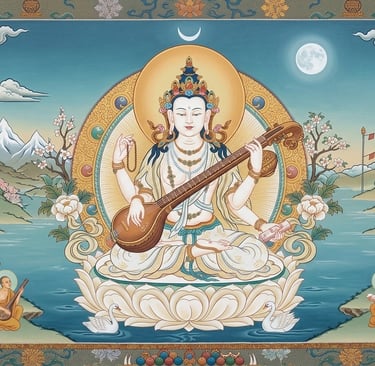
In the Hindu context, Saraswati is the goddess of the word Vac, representing the primordial sound that brought the universe into being. She is typically depicted in pristine white, seated upon a swan or a lotus, holding a veena, a book, and prayer beads. When Buddhism began to flourish, it did not discard these powerful archetypes; instead, it integrated them, viewing Saraswati as a manifestation of the wisdom that leads to enlightenment. In the Vajrayana tradition, she is often seen as the female counterpart or consort of Manjushri, the Bodhisattva of Wisdom. This pairing is significant because it suggests that wisdom is not a static, dry collection of facts, but a vibrant, melodic, and expressive force. If Manjushri represents the sharp sword of intellect that cuts through delusion, Saraswati represents the song that arises once the truth is known. Together, they demonstrate that the ultimate reality is both profoundly clear and infinitely creative.
The transition of Saraswati from a river goddess to a Buddhist muse highlights a critical shift in how we view the "flow" of consciousness. Just as a river purifies the land it touches, the "flow" of creative inspiration is seen in Buddhism as a method of purifying the mind. When an artist, musician, or writer enters a state of deep focus what modern psychology might call "flow" and what ancient traditions might call "Samadhi" the small, nagging voice of the ego begins to fade. In these moments of pure expression, the distinction between the creator, the act of creating, and the creation itself begins to dissolve. This is the intersection where art becomes a spiritual practice. Saraswati serves as the guiding energy for this process, reminding the practitioner that the pursuit of beauty is not a distraction from the path of liberation, but a vehicle for it.
Central to the Buddhist interpretation of Saraswati is the concept of "Right Expression," an extension of the Right Speech found in the Noble Eightfold Path. While Right Speech often focuses on abstaining from lies or harsh words, Right Expression through the lens of Saraswati suggests an active, positive engagement with the world. It posits that the way we communicate our inner truth whether through a painting, a melody, or a well-crafted sentence has the power to either entangle us further in illusion or set us free. When creativity is fueled by vanity or the desire for fame, it reinforces the ego. However, when it is practiced as a devotion to Saraswati, it becomes an act of "egolessness." The artist becomes a conduit for a wisdom that is larger than their individual personality, allowing the "divine" or the "enlightened" to speak through them.
This perspective challenges the Western "tortured artist" trope, which suggests that great art must come from a place of personal suffering and chaotic emotionality. The Buddhist Muse suggests the opposite: that the highest forms of art arise from a mind that is clear, stable, and compassionate. Saraswati’s music is said to harmonize the elements and soothe the restless spirits of the world. Therefore, the creative path is one of refinement. To be a true devotee of Saraswati is to work on one’s character as much as one’s craft. The discipline required to master an instrument or a poetic meter mirrors the discipline required to master the mind. Every hours spent practicing a scale or refining a brushstroke is an exercise in patience, mindfulness, and the letting go of immediate gratification. In this light, the studio or the rehearsal hall becomes a temple.
The pursuit of art as a path to self-realization also involves the recognition of "emptiness," a core Buddhist tenet. When a musician plays a beautiful note, where does the beauty reside? It is not in the wood of the instrument, nor solely in the vibrating air, nor even in the ear of the listener. It arises from a complex web of causes and conditions and then immediately vanishes. By meditating on the fleeting nature of sound and color, the artist learns to appreciate life without clinging to it. Saraswati, with her veena, symbolizes this delicate balance. The strings of the veena must be neither too tight nor too loose to produce the perfect tone—a direct metaphor for the "Middle Way" taught by the Buddha. The artist lives in this tension, striving for perfection while knowing that the result is as ethereal as the scent of incense.
Furthermore, Saraswati’s role as the patron of eloquence speaks to the power of the "Sacred Word" to transform the environment. In the Buddhist tradition, the chanting of mantras and the recitation of sutras are central practices. Saraswati is the energy behind these sounds. She represents the capacity for language to transcend its mundane function of conveying information and instead become a tool for energetic shifts. When we speak with "Saraswati energy," our words carry a weight and a resonance that can heal others or provide sudden moments of insight. This is why she is so highly regarded by scholars and orators. They recognize that eloquence is not about cleverness or sophisticated vocabulary; it is about the alignment of one’s inner realization with one’s outer expression.
The intersection of these two great religions in the form of a single goddess reminds us of the universality of the human creative urge. Whether she is called Saraswati in a Hindu temple or Benzaiten in a Japanese Buddhist shrine, her message remains remarkably consistent: our ability to create is our most "god-like" or "enlightened" quality. It is the bridge between the material world and the spiritual realm. By honoring the muse, we are not worshipping an external entity so much as we are acknowledging the luminous potential within our own voices and hands. We are admitting that the world is not just a place of suffering to be escaped, but a canvas to be painted with the colors of wisdom and compassion.
As we navigate an increasingly digital and distracted age, the archetype of Saraswati is more relevant than ever. She calls us back to the slow, deliberate work of deep creativity. She invites us to put down the noise of the ego and pick up the "instrument" of our choice be it a pen, a tool, or a simple act of kind speech. In the silence that follows a beautiful piece of music or the space at the end of a profound poem, we find a glimpse of the peace that the Buddha sought. We realize that the path to enlightenment does not always require sitting in a cave; sometimes, it requires singing a song so true that the "I" who started singing it simply disappears. Saraswati stands at that threshold, smiling, reminding us that the most beautiful masterpiece we will ever create is the realization of our own true nature.
Sera Jey Wisdom Center
A Gelug Tibetan Buddhist center in Jakarta. Join our weekly prayers every Saturday at 2 PM — everyone is welcome.
Address
Sera Jey Wisdom Center
Ruko Savoy Blok C1 No.31 & 32,
River Garden Jakarta Garden City,
Cakung Timur, Jakarta Timur 13910,
Indonesia
© 2026 Sera Jey Wisdom Center Jakarta. All rights reserved.