
Palden Lhamo: Buddhist Protector Goddess
Discover the fierce and compassionate presence of Palden Lhamo (Sri Devi), the sole female protector goddess in Tibetan Buddhism, whose powerful gaze safeguards the Dharma and its practitioners.
Palden Lhamo, known in Sanskrit as Sri Devi, stands as a formidable and profoundly significant deity within the rich tapestry of Tibetan Buddhism.
She is unique as the only female among the traditional eight Dharma Protectors, a pantheon of powerful beings sworn to defend the Buddhist teachings and their followers from all obstacles and negativity. Her iconography is striking, often depicting her as a wrathful emanation, a necessary and compassionate display of power intended to subdue malevolent forces and clear the path for spiritual progress. This wrathful appearance, though initially startling, is understood not as an expression of anger in the conventional sense, but rather as an active, potent force of enlightened wisdom and boundless compassion.
It is a fierce dedication to protecting sentient beings from suffering, even if it requires confronting and transforming the deepest obscurations and hindrances. Her presence serves as a constant reminder that the path to enlightenment is not always serene; it requires unwavering resolve and protection against internal and external adversities.
The origins of Palden Lhamo are steeped in ancient lore and diverse cultural influences, reflecting the syncretic nature of Tibetan Buddhism. While deeply integrated into the Buddhist pantheon, some narratives trace aspects of her veneration back to pre-Buddhist traditions, possibly incorporating elements of indigenous protector spirits or fierce goddesses. In Buddhist cosmology, she is often considered a wrathful emanation of Saraswati, the goddess of wisdom, arts, and learning, or sometimes even as an emanation of Tara, another beloved female Buddha known for her swift compassion.
This connection underscores her role not just as a physical protector, but as a guardian of wisdom itself, ensuring that the profound insights of the Dharma are preserved and understood. Her transformation into a Dharma Protector is often recounted through stories of great spiritual devotion and a solemn vow to safeguard the teachings, an oath she fulfills with unyielding determination. These narratives emphasize her deep connection to the lineage of enlightened masters and her unwavering commitment to the spread of the Dharma throughout the world.
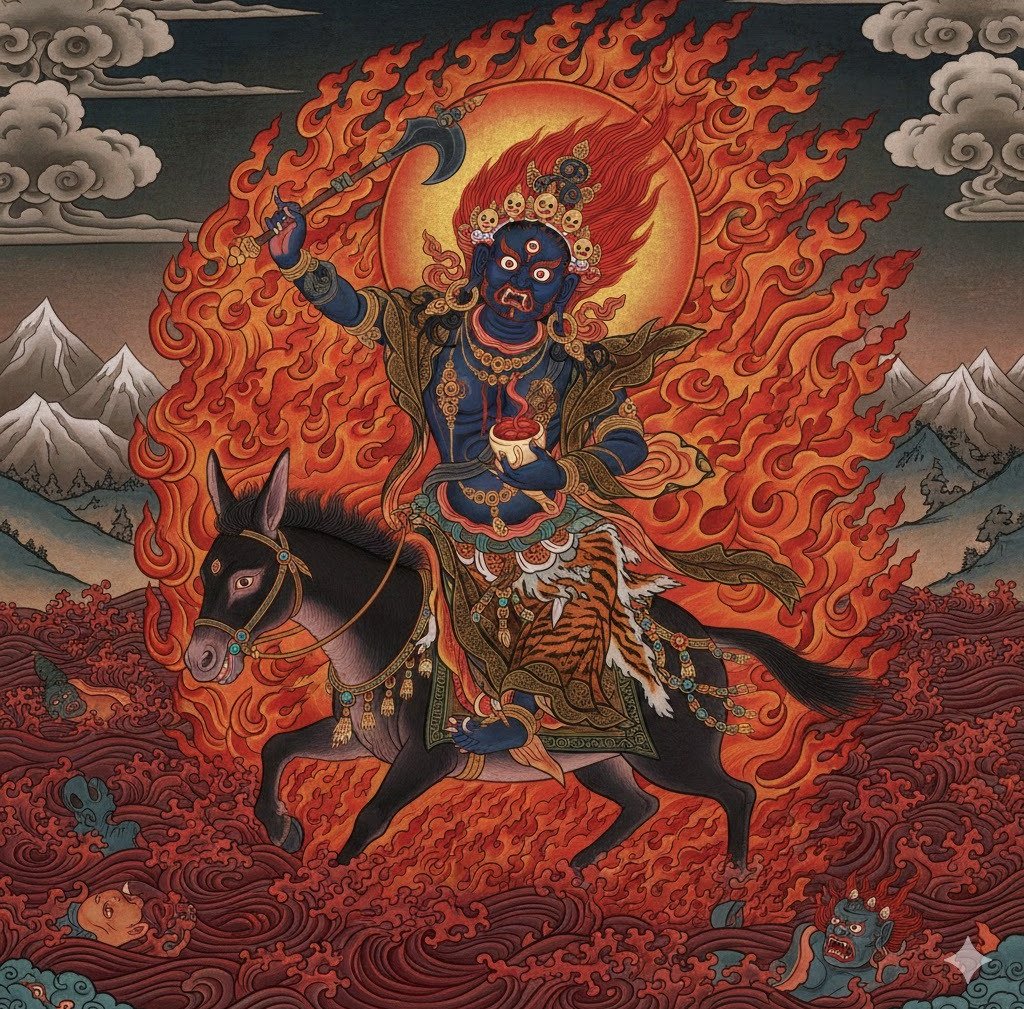
Palden Lhamo's visual representation is perhaps one of the most recognizable and impactful in Tibetan Buddhist art. She is typically depicted riding a mule, often across a sea of blood, a vivid and symbolic representation of her journey through the cycle of suffering (samsara) to rescue beings. Her body is a dark blue or black, symbolizing the ultimate reality of emptiness (shunyata) and her unchangeable nature.
She possesses one face with three eyes, signifying her ability to see the past, present, and future, and her profound insight into the true nature of reality. Her flaming red hair stands on end, symbolizing her wrathful energy and her complete transformation beyond ordinary human limitations. In her right hand, she typically holds a skull-tipped staff or a sword, implements used to cut through ignorance and delusion. Her left hand often holds a skull cup filled with blood or nectar, symbolizing the subjugation of negative forces and the offering of wisdom. She wears a crown of five skulls, representing the five poisons (ignorance, attachment, aversion, pride, and jealousy) transformed into the five wisdoms.
Adorned with a necklace of freshly severed heads, she serves as a powerful reminder of the impermanence of life and the ultimate victory over death and ego. These powerful symbols are not meant to inspire fear in devotees but to convey her extraordinary power and her unwavering commitment to the Dharma.
The spiritual significance of Palden Lhamo extends far beyond her visual depiction; she is a deeply revered figure who plays a crucial role in the spiritual lives of practitioners. As the principal protector of the Dalai Lamas and the Tibetan government, her importance is paramount within the Gelug school of Tibetan Buddhism, though she is venerated across all traditions. Her protective function is multifaceted. She guards against external threats, such as war, famine, and natural disasters, and is invoked for general well-being and the removal of obstacles. More profoundly, she is invoked to protect against internal obstacles, he subtle and pervasive mental afflictions that hinder spiritual progress.
These include doubt, pride, attachment, and the myriad forms of ignorance that keep beings entangled in samsara. By supplicating Palden Lhamo, practitioners seek her aid in dispelling these inner demons, purifying negative karma, and cultivating the wisdom and compassion necessary for enlightenment. Her fierce compassion motivates her to intervene actively in the lives of those who genuinely seek the Dharma, offering swift and potent assistance when called upon with sincere devotion.
The practice associated with Palden Lhamo often involves elaborate rituals, prayers, and mantra recitation. Devotees engage in specific sadhanas (meditation practices) dedicated to her, visualizing her powerful form and reciting her mantra to invoke her blessings and protection. These practices are believed to generate immense merit, purify negativities, and strengthen one's connection to the Dharma. Her mantra, a sacred utterance, is thought to encapsulate her essence and power, allowing practitioners to tap into her protective energy directly.
During times of crisis or when facing significant challenges, many Buddhists turn to Palden Lhamo, seeking her swift intervention and guidance. Her fierce resolve inspires practitioners to cultivate their own inner strength and courage to face life's difficulties with resilience. Furthermore, engaging with her practice is understood as a way to cultivate one's own innate wrathful compassion, the ability to act decisively and powerfully to alleviate suffering, even if it requires confronting difficult truths or challenging conventional norms. It is a reminder that compassion can take many forms, including a powerful, transformative wrath that cuts through delusion.
Beyond her role as a personal and institutional protector, Palden Lhamo also embodies the principle of enlightened feminine power within Buddhism. In a tradition that, at times, has been perceived as patriarchal, her prominent status as a fierce, independent, and ultimately benevolent female deity highlights the crucial role of the feminine in achieving enlightenment. She represents the dynamic, active aspect of wisdom and compassion, the force that actively engages with the world to transform suffering. Her ferocity is not destructive in a negative sense, but rather a cleansing fire that purifies and clears the path.
This embodiment of powerful feminine energy offers inspiration to both male and female practitioners, demonstrating that strength, wisdom, and the ability to protect the Dharma are not limited by gender. She is a symbol of empowerment, showing that even the most formidable challenges can be overcome through unwavering dedication and enlightened action. Her unwavering commitment to her vows reinforces the importance of ethical conduct and the power of sincere aspiration in the Buddhist path.
In essence, Palden Lhamo is far more than just a fierce image; she is a living symbol of unwavering protection, profound wisdom, and boundless compassion. Her presence in the Buddhist pantheon underscores the belief that spiritual progress requires both gentle nurturing and fierce protection from all forms of obstruction. Through her wrathful yet ultimately benevolent form, she guides practitioners through the turbulent waters of existence, cutting through delusions, purifying negativities, and safeguarding the precious Dharma.
Her story and iconography continue to inspire millions, reminding them that even in the face of immense challenges, an enlightened force stands ready to protect and guide those who sincerely walk the path to liberation. She is a testament to the diverse and profound ways that enlightenment manifests, demonstrating that true compassion can be expressed with a formidable power that ultimately serves to benefit all sentient beings. Her enduring presence is a source of strength, solace, and inspiration for all who seek wisdom and liberation.
Sera Jey Wisdom Center
A Gelug Tibetan Buddhist center in Jakarta. Join our weekly prayers every Saturday at 2 PM — everyone is welcome.
Address
Sera Jey Wisdom Center
Ruko Savoy Blok C1 No.31 & 32,
River Garden Jakarta Garden City,
Cakung Timur, Jakarta Timur 13910,
Indonesia
© 2026 Sera Jey Wisdom Center Jakarta. All rights reserved.