
Padmasambhava (Guru Rinpoche)
Known as the "Second Buddha," Padmasambhava (Guru Rinpoche) is the tantric master who brought Buddhism to Tibet. Famed for his miraculous birth in a lotus and his power to subdue demons, he represents the ultimate union of wisdom and spiritual energy. His legacy lives on through "terma" (hidden treasures) teachings buried across time for future generations to discover.
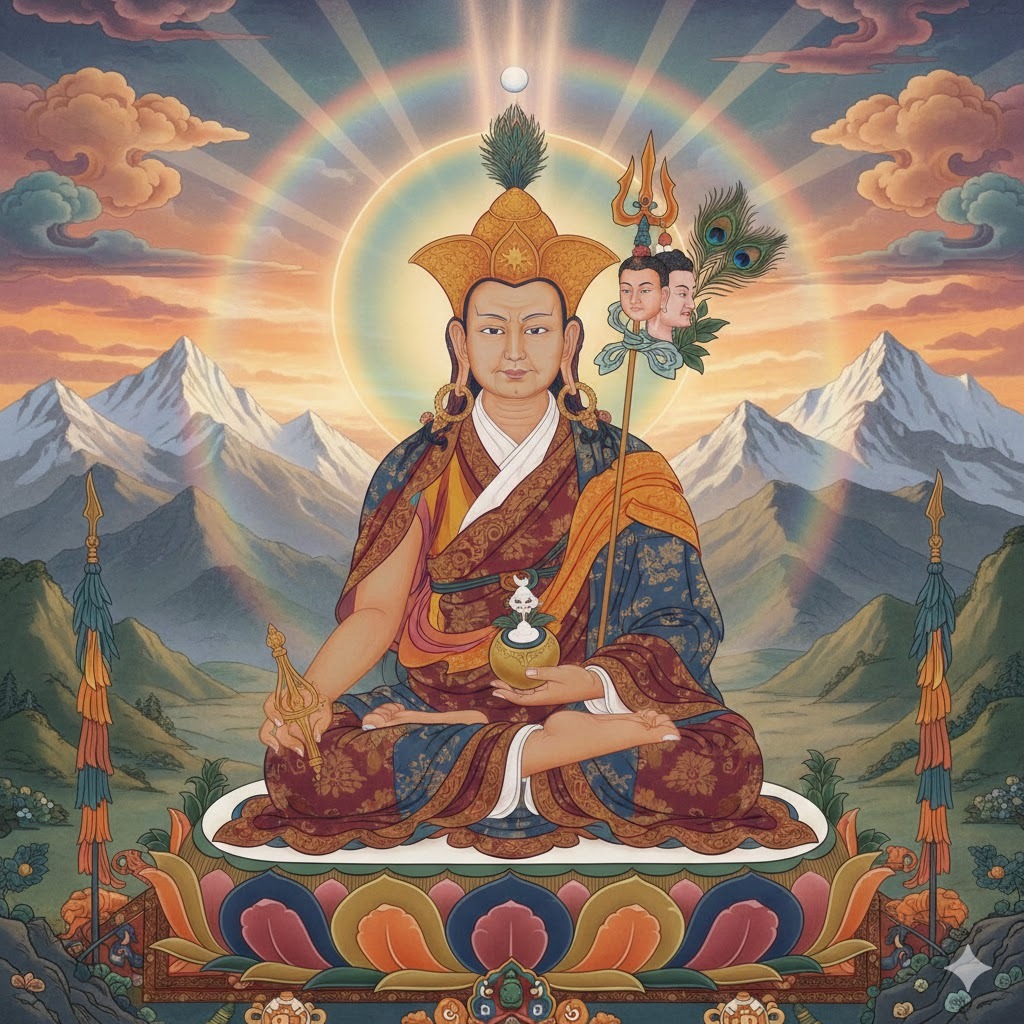
Padmasambhava, reverently known as Guru Rinpoche, or the "Precious Master," is a figure of paramount importance in Tibetan Buddhism, credited with its establishment in Tibet during the 8th century.
His life story, though shrouded in myth and legend, recounts a pivotal period in the spiritual history of the Himalayas, transforming a land steeped in animistic beliefs into a vibrant center of Buddhist learning and practice. He is considered the founder of the Nyingma school, the oldest of the four major schools of Tibetan Buddhism, and his teachings and legacy continue to profoundly influence all traditions. The narratives surrounding his birth and early life are rich with symbolic meaning, often depicting him as supernaturally born from a lotus flower in the Dhanakosha lake in Oddiyana, a region often identified with modern-day Swat Valley in Pakistan. This miraculous birth, as opposed to conventional human parentage, underscores his enlightened nature and divine mandate. He is said to have appeared as an eight-year-old child, already possessing profound wisdom and compassion, a perfect embodiment of the Buddha's teachings.
From his miraculous birth, Padmasambhava embarked on a journey of intense spiritual training and mastery. He is said to have studied under numerous enlightened masters in India, mastering all aspects of the Outer and Inner Tantras, as well as the common sciences. His education was not merely academic; it involved rigorous meditation, ascetic practices, and the direct realization of the ultimate nature of reality. He displayed extraordinary powers, including clairvoyance, the ability to subdue hostile spirits, and the capacity to manifest in various forms to suit the needs of his disciples. These abilities were not seen as mere magic but as the natural outcome of his profound spiritual attainments and his unwavering commitment to the Dharma. His reputation as a powerful tantric master spread throughout India, earning him the title "Padmasambhava," meaning "Lotus-Born."
The critical turning point in Padmasambhava's life, and in the history of Tibet, came with an invitation from the Tibetan King Trisong Detsen. The king, a fervent Buddhist, was facing immense difficulties in establishing Buddhism in his realm. Local deities and malevolent spirits, deeply ingrained in the indigenous Bön religion, were resisting the new spiritual order, causing natural disasters and obstructing construction efforts for the first Buddhist monastery at Samye. Shantarakshita, the Indian abbot who had initially been invited to establish Buddhism, advised the king that only a powerful tantric master like Padmasambhava could subdue these hostile forces. Recognizing the urgency, King Trisong Detsen dispatched emissaries to invite the great Guru to Tibet, setting in motion an event that would irrevocably alter the spiritual landscape of the land.
Upon his arrival in Tibet, Padmasambhava's mission was twofold: to subdue the indigenous deities and spirits and to propagate the Buddhist teachings. He traversed the vast and rugged Tibetan plateau, confronting and converting malevolent forces, transforming them into protectors of the Dharma. These encounters are vividly described in numerous biographies, often depicting him as a fearless spiritual warrior wielding his tantric powers with wisdom and compassion. He did not annihilate the local spirits but rather bound them by oath to serve the cause of Buddhism, integrating them into the Buddhist pantheon as Dharma protectors. This strategic approach, rather than outright confrontation, allowed for a more harmonious integration of the new religion with existing indigenous beliefs, a testament to his profound understanding of the Tibetan psyche and culture.
With the spiritual obstacles cleared, Padmasambhava collaborated with King Trisong Detsen and the esteemed scholar-monk Shantarakshita to oversee the construction of Samye Monastery, the first Buddhist monastery in Tibet. This monumental undertaking was completed around 779 CE, marking the formal establishment of the monastic tradition in Tibet. Samye was designed as a mandala, a symbolic representation of the cosmos, and became a crucial center for the translation of Buddhist scriptures from Sanskrit into Tibetan, a task that Padmasambhava himself greatly facilitated. He initiated many Tibetans into the tantric path, transmitting profound teachings and empowerments that laid the foundation for the Nyingma tradition. His direct disciples, known as the "Twenty-five Great Disciples," played a vital role in preserving and disseminating his teachings, ensuring their continuity for future generations.
Padmasambhava's teachings emphasized the Vajrayana path, a unique and powerful vehicle within Buddhism that utilizes tantric methods to achieve enlightenment in a single lifetime. He stressed the importance of devotion to the guru, the practice of mantra recitation, visualization, and the direct realization of the mind's true nature, known as Mahamudra or Dzogchen. He understood that while the sutra path, emphasizing gradual accumulation of merit and wisdom, was essential, the tantric path offered an accelerated means to liberation for those with the appropriate capacity and diligence. His teachings were not merely theoretical; they were practical instructions designed to transform the practitioner's mind and lead to ultimate freedom from suffering. He provided extensive instructions on meditation, ritual, and the profound view of emptiness and compassion, tailoring his guidance to the specific needs and understanding of his diverse disciples.
Beyond his direct teachings, Padmasambhava is renowned for concealing numerous "termas" or "treasure texts" throughout Tibet. These treasures, both material and spiritual, were hidden in various locations—rocks, caves, lakes, and even in the minds of his disciples—to be discovered at auspicious times by future "tertons" or "treasure revealers." The terma tradition is a unique and vibrant aspect of Tibetan Buddhism, particularly within the Nyingma school, ensuring the fresh and timely revelation of teachings relevant to each new era. This foresight ensured the preservation of the Dharma during periods of persecution and provided a mechanism for the continuous revitalization and adaptation of the teachings. The termas include a wide range of texts, from sadhanas (meditation practices) and empowerments to prophecies and historical accounts, all attributed to Padmasambhava himself.
As his time in Tibet drew to a close, Padmasambhava did not simply pass away in the conventional sense. According to tradition, he departed for the pure land of Zangdok Palri, the Copper-Colored Mountain, a celestial realm where he continues to reside as the regent of the Vajrayana teachings, perpetually working for the benefit of all sentient beings. His departure is often depicted as a mystical ascension, riding a ray of light or a magical horse, accompanied by a retinue of dakinis. This symbolic exit reinforces his transcendent nature and the enduring power of his blessings. Even today, practitioners invoke his presence and seek his guidance, believing that he remains accessible through devotion and sincere practice. The vision of Zangdok Palri is a powerful aspiration for many Nyingma practitioners, who strive to be reborn there to continue their spiritual journey under his direct tutelage.
Padmasambhava's legacy is immeasurable. He is not merely a historical figure but a living presence for millions of Tibetan Buddhists. His images and statues adorn temples and homes throughout the Himalayas, and his mantra, Om Ah Hum Vajra Guru Padma Siddhi Hum, is recited countless times daily. He is seen as the embodiment of all Buddhas and bodhisattvas, a source of immense blessings and protection. His teachings, particularly those pertaining to Dzogchen, are considered the highest and most profound within Tibetan Buddhism, offering a direct path to the realization of one's innate enlightened nature. The Nyingma school, founded on his teachings, continues to thrive, preserving and transmitting the ancient traditions he brought to Tibet.
The narrative of Padmasambhava's life also serves as a profound allegory for the spiritual journey itself. His battles with demons and spirits represent the inner struggle against one's own delusions, negative emotions, and egoistic tendencies. His mastery of tantric practices symbolizes the transformation of these obstacles into allies on the path to enlightenment. His establishment of Buddhism in Tibet is a metaphor for the successful integration of spiritual principles into one's daily life and the creation of a harmonious inner and outer world. Through his extraordinary life and teachings, Padmasambhava continues to inspire practitioners to cultivate wisdom, compassion, and courage, guiding them towards the ultimate realization of their true potential. His profound impact extends beyond religious boundaries, offering universal lessons on overcoming adversity, fostering inner peace, and dedicating oneself to the well-being of all.
Sera Jey Wisdom Center
A Gelug Tibetan Buddhist center in Jakarta. Join our weekly prayers every Saturday at 2 PM — everyone is welcome.
Address
Sera Jey Wisdom Center
Ruko Savoy Blok C1 No.31 & 32,
River Garden Jakarta Garden City,
Cakung Timur, Jakarta Timur 13910,
Indonesia
© 2026 Sera Jey Wisdom Center Jakarta. All rights reserved.