
Mahakala: Black Protector And Guardian of the Dharma
Discover the profound mystery of Mahakala, the "Black Protector." Beyond his fearsome appearance lies a manifestation of enlightened fury and boundless compassion dedicated to shielding the Dharma.
Mahakala, often depicted as a fearsome, wrathful deity, holds a pivotal and deeply revered position within the pantheon of Vajrayana Buddhism, particularly in the Tibetan traditions. Far from being a malevolent entity, his terrifying appearance serves as a potent symbol of his relentless compassion and his unyielding commitment to protecting the Dharma, the teachings of the Buddha. He is, in essence, a manifestation of enlightened fury, directed not at sentient beings, but at the obscurations, delusions, and negative forces that hinder spiritual progress. To understand Mahakala is to look beyond the surface of wrath and perceive the profound wisdom and boundless empathy that lie beneath his fierce exterior.
The origins of Mahakala can be traced back to India, where he emerged as a protector deity associated with various Hindu traditions, notably Shiva. As Buddhism evolved and traveled, particularly into Tibet, it assimilated and transformed many local deities and concepts, integrating them into its own sophisticated philosophical and meditative systems. Mahakala, in this process, became a principal Dharma protector, embodying the active, powerful defense of the Buddhist path. His evolution reflects the dynamic nature of Vajrayana, which often employs striking and sometimes startling imagery to convey deep spiritual truths that defy conventional understanding. The adoption of such formidable figures was also a pragmatic response to the often-challenging environments in which Buddhism sought to establish itself, providing a sense of security and reassurance to practitioners.
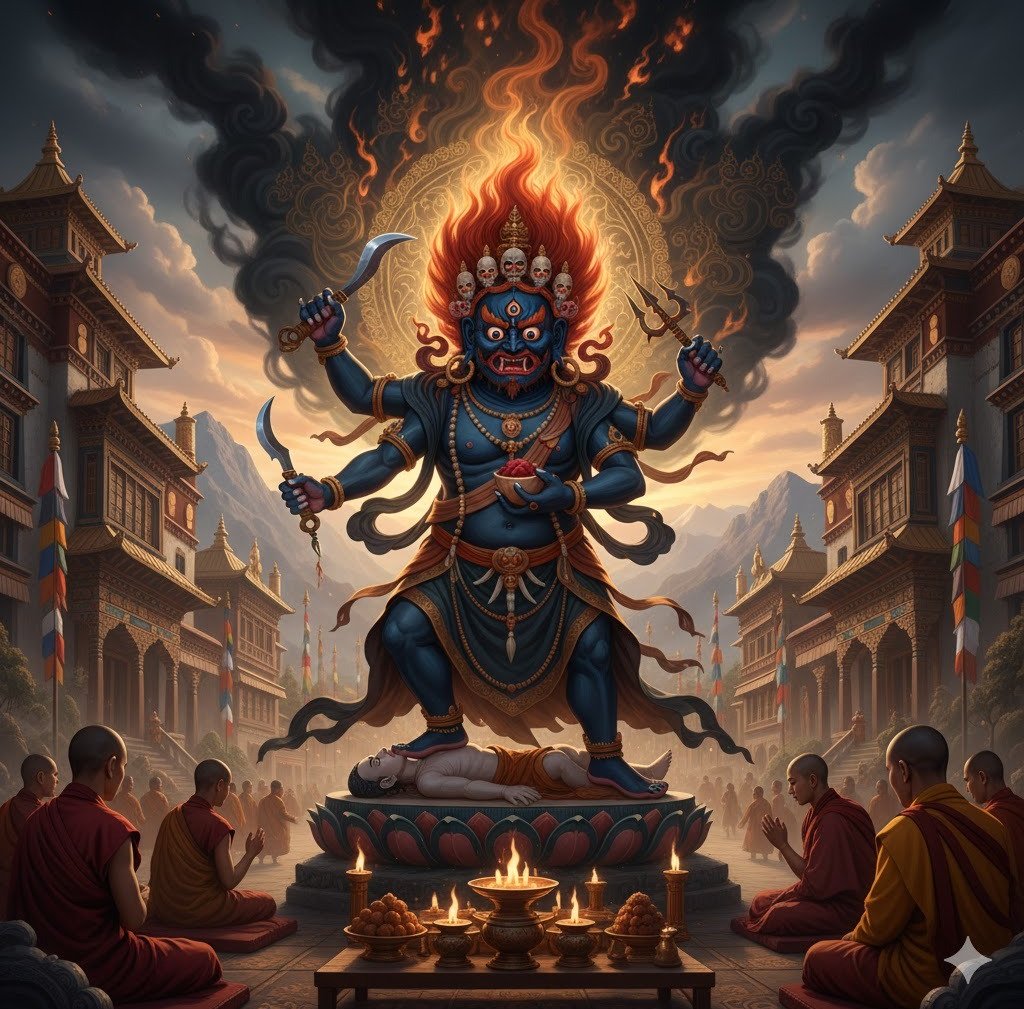
Mahakala is not a single entity but a class of deities, each with distinct forms, attributes, and specific functions, yet all sharing the fundamental role of Dharma protector. Common forms include the Six-Armed Mahakala (Shadbhuj Mahakala), often associated with the Shangpa Kagyu and Gelug schools; Four-Armed Mahakala (Chaturbhuj Mahakala), prevalent in the Karma Kagyu tradition; and Two-Armed Mahakala (Bernakchen), a primary protector of the Karma Kagyu and Nyingma lineages. Each form carries specific implements and symbols, but universally, they appear with dark blue or black skin, flaming hair, bulging eyes, fangs, and a crown of five skulls, representing the transmutation of the five disturbing emotions into the five wisdoms. The black color symbolizes his all-encompassing nature, absorbing all hues, just as ultimate reality transcends all distinctions and forms. It also signifies his unchanging, primordial nature.
The wrathful iconography of Mahakala is replete with symbolic meaning, each element designed to communicate a profound spiritual message. His bulging eyes gaze fiercely, symbolizing his omniscient awareness, perceiving all obstacles, internal and external. The sharp fangs and protruding tongue signify his power to destroy delusion and negativity. His flaming hair, standing on end, represents his blazing energy and consuming wrath against ignorance. He often stands atop a prostrate human figure, symbolizing the vanquishing of ego and self-cherishing, the root causes of suffering. The implements he holds—such as a curved knife (kartika) for severing attachments, a skull cup (kapala) filled with blood (symbolizing the pristine awareness of bliss and emptiness), and a trident—further elaborate on his role as a transformer of defilements into wisdom. His wrath is thus not driven by hatred, but by fierce compassion, cutting through obstacles that prevent sentient beings from realizing their true nature.
Mahakala’s role as a protector extends beyond merely fending off external threats. He is invoked to protect practitioners from inner obstacles, such as doubt, laziness, attachment, and aversion, which are often more insidious and difficult to overcome than external adversaries. He helps to clear away obscurations on the path to enlightenment, providing strength and courage to face one's own inner demons. In this sense, his wrath becomes a metaphor for the intense self-discipline and rigorous practice required to achieve spiritual liberation. He is a guardian of the vows and commitments made by practitioners, ensuring they remain steadfast on their chosen path.
The practice involving Mahakala is typically restricted to advanced practitioners who have received proper empowerment and guidance from a qualified lama. This is because engaging with such powerful, wrathful energies without proper preparation and understanding can be dangerous. However, even for lay practitioners, respectful veneration of Mahakala, often through offerings and prayers, is common. Monasteries and Dharma centers often have a specific shrine dedicated to Mahakala, where daily rituals and offerings are performed to supplicate him for protection and to maintain harmony within the community. These rituals are elaborate and precise, involving specific chants, mudras, and visualizations, all aimed at connecting with Mahakala's enlightened energy.
In many monastic settings, Mahakala is considered the primary protector of the monastery itself and its lineage. For example, in the Gelug tradition, Six-Armed Mahakala is a prominent protector, deeply intertwined with the lineage of the Dalai Lamas. In the Karma Kagyu school, Two-Armed Mahakala (Bernakchen) holds a similar significance, diligently safeguarding its teachings and practitioners. The monks dedicate substantial portions of their practice to propitiating these protectors, believing that their watchful presence ensures the flourishing of the Dharma and the safety of the community. This protective function is seen as vital for the transmission of teachings and the continuity of the spiritual lineage from one generation to the next.
The veneration of Mahakala also serves as a reminder of the impermanence of all phenomena and the need to confront the darker aspects of existence, both externally and within oneself. His terrifying visage encourages practitioners to transcend fear, to realize that ultimate reality is beyond conventional notions of beauty and ugliness, comfort and terror. By embracing the wrathful aspect of enlightenment, one learns to integrate all experiences, even the challenging ones, into the path of awakening. He represents the fearless wisdom that is not intimidated by any obstacle, internal or external.
Ultimately, Mahakala, the Black Protector, is a profound symbol of enlightened compassion expressed through fierce action. He is not a god to be appeased through fear, but a manifestation of pristine awareness that relentlessly cuts through delusion and protects the path to liberation. His terrifying appearance is a skillfully employed upaya, a skillful means, to shake practitioners out of complacency and to instill in them the courage and determination necessary to face the arduous journey towards Buddhahood. Through his fierce gaze and powerful implements, Mahakala continuously reminds practitioners that the path to enlightenment demands unwavering commitment, the courage to confront internal and external obstacles, and the profound wisdom to transform all negativities into opportunities for awakening. His unwavering commitment to the Dharma ensures its continuity and flourishing for the benefit of all sentient beings.
Sera Jey Wisdom Center
A Gelug Tibetan Buddhist center in Jakarta. Join our weekly prayers every Saturday at 2 PM — everyone is welcome.
Address
Sera Jey Wisdom Center
Ruko Savoy Blok C1 No.31 & 32,
River Garden Jakarta Garden City,
Cakung Timur, Jakarta Timur 13910,
Indonesia
© 2026 Sera Jey Wisdom Center Jakarta. All rights reserved.