Hevajra: The Embodiment of Wisdom and Method in Tantric Buddhism
Meet Hevajra, a key meditational deity in Tibetan Buddhism, who represents the perfect fusion of wisdom (prajna) and method (upaya). Central to the highest class of Buddhist tantras, Hevajra's complex, multi-limbed, and fierce form is a map for profound internal transformation. With eight faces, sixteen arms, and four legs, he embraces his consort, Nairatmya (No-Self), symbolizing the non-dual union necessary for enlightenment. This powerful iconography helps practitioners cut through delusion and realize their innate Buddha-nature, proving that the fierce aspects of tantra are simply compassionate means for achieving ultimate freedom.
Hevajra: The Embodiment of Wisdom and Method in Tantric Buddhism
Hevajra, a prominent meditational deity in Vajrayana Buddhism, particularly within the Sakya, Kagyu, and Gelug traditions of Tibetan Buddhism, embodies the profound union of wisdom (prajna) and method (upaya). He is a central figure in the Hevajra Tantra, a foundational text belonging to the Anuttarayoga Tantra class, which is considered the highest and most profound of the Buddhist tantras. His iconography, rich with symbolic meaning, visually expresses the sophisticated philosophical and meditative principles of the tantric path, guiding practitioners towards the realization of ultimate truth and the attainment of Buddhahood for the benefit of all sentient beings. To understand Hevajra is to delve into the heart of tantric practice, where seemingly fierce and complex forms are revealed as potent metaphors for internal transformations and the overcoming of dualistic perception.
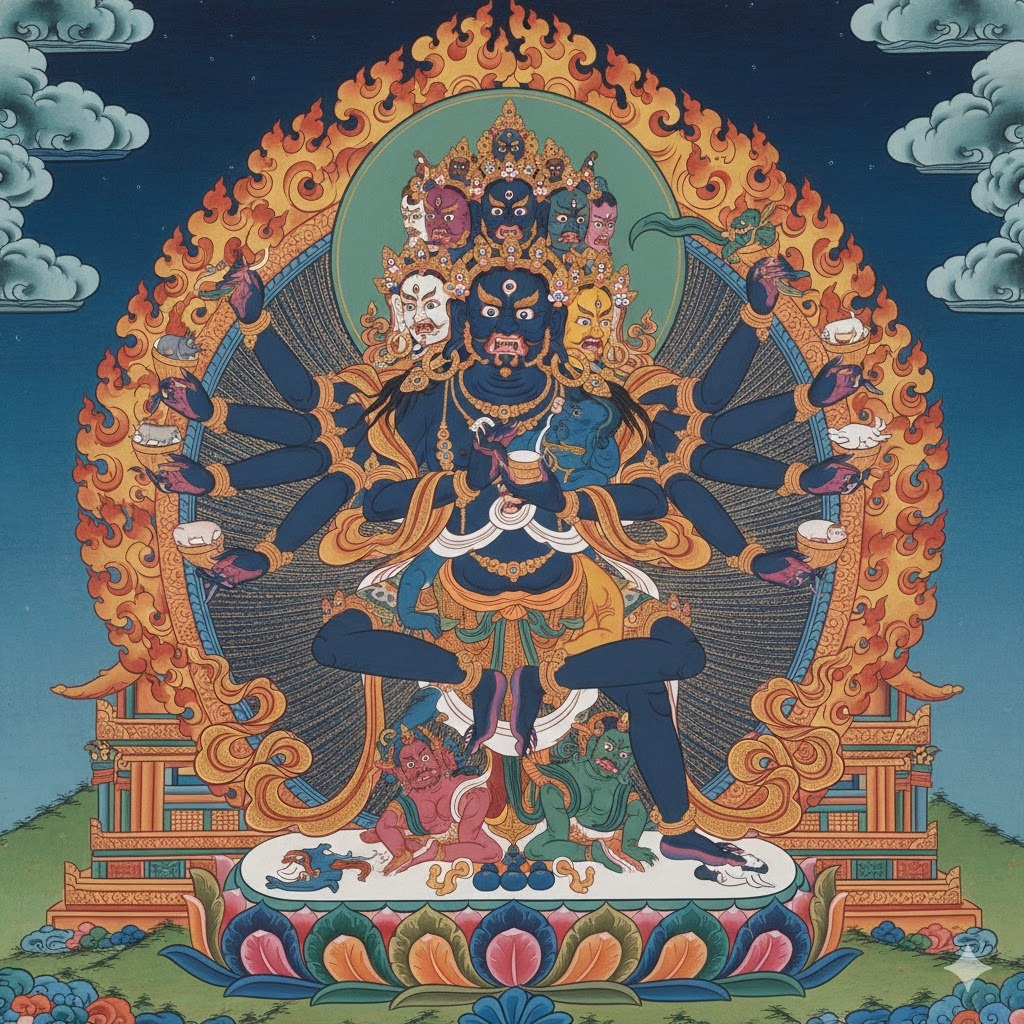
The name Hevajra itself carries significant meaning. "He" is an exclamation, often interpreted as addressing the yogin directly, calling them to awaken. "Vajra" refers to the diamond scepter, symbolizing indestructibility, adamantine wisdom, and the ultimate nature of reality, emptiness. Together, Hevajra can be understood as "O Vajra!" or "Behold the Indestructible!" an invocation to experience the unshakeable truth of phenomena. Hevajra is typically depicted in various forms, most notably with eight faces, sixteen arms, and four legs, embracing his consort, Nairatmya (literally "No-Self"), who embodies wisdom. This embrace is the quintessential tantric symbol of the union of method (Hevajra's active, skillful means) and wisdom (Nairatmya's realization of emptiness), indispensable for achieving enlightenment. The multiple heads, arms, and legs are not literal but represent the deity's omniscient awareness, omnipotent activity, and liberation from the constraints of samsara.
Each of Hevajra’s eight faces symbolizes a different aspect of his enlightened mind. While the central face is typically blue or black, representing the ultimate reality, the other faces often display a range of colors, each corresponding to specific purified delusions or awakened qualities. These faces gaze in all directions, signifying his pervasive awareness and his ability to perceive all phenomena simultaneously. His sixteen arms hold various implements, each imbued with symbolic significance related to the path to enlightenment. In his right hands, Hevajra often holds skulls filled with animals (elephant, horse, ass, ox, camel, human, lion, cat), symbolizing the eight common siddhis (extraordinary attainments) and the purification of the eight types of consciousness or the eight worldly concerns. In his left hands, he holds skulls filled with various deities, representing the eight transcendent siddhis and the wisdom aspect of the path. This complex iconography serves as a mnemonic device and a meditative focus, guiding the practitioner through a structured visualization that systematically purifies obscurations and cultivates awakened qualities.
Hevajra's four legs are also highly symbolic. Two legs are typically pressed down, and two are raised, indicating his liberation from the cycle of samsara and his active engagement in the world to benefit others. He often stands upon four Māras (demons of delusion, death, emotional defilements, and the aggregates of existence), symbolizing his complete subjugation of these obstacles to enlightenment. His stance, therefore, embodies both transcendental wisdom and compassionate activity. The presence of his consort, Nairatmya, is equally crucial. She is depicted holding a curved knife and a skull cup, symbolizing the cutting of delusion and the emptiness of all phenomena, respectively. Her name, "No-Self," directly points to the fundamental Buddhist doctrine of anatta, the absence of an inherent, unchanging self. Their passionate embrace is not a depiction of mundane sensuality but a profound metaphor for the non-dual union of ultimate reality (emptiness) and compassionate manifestation. It signifies that enlightenment is not a solitary or abstract state but a dynamic fusion of profound insight and active engagement with the world.
The practice of Hevajra Tantra involves complex rituals, visualizations, and meditations that aim to transform ordinary perception into enlightened wisdom. Practitioners identify with the deity, visualizing themselves as Hevajra, thereby internalizing his qualities and insights. This process, known as deity yoga, is not an act of worship in the conventional sense but a method of self-transformation. By dissolving one's ordinary sense of self into the pure form of the deity, practitioners seek to transcend their habitual patterns of thought and emotion, ultimately realizing their own innate Buddha-nature. The tantra also emphasizes the importance of a qualified guru, who provides guidance and empowers the practitioner through initiation (wang), ensuring the proper understanding and practice of these profound teachings. Without proper guidance, the complex symbolism and powerful energies invoked in tantric practice can be misunderstood or misused.
The Hevajra Tantra is particularly renowned for its exposition of the "six doctrines" or "six topics," which outline the stages of practice leading to enlightenment. These include the purification of the six elements, the six sense faculties, and the six consciousnesses, among other intricate stages of meditative development. It also delves into the nature of the subtle body, including the channels (nadis), winds (pranas), and drops (bindus), which are manipulated through advanced yogic practices to achieve profound states of consciousness. The ultimate goal is the realization of the "clear light mind," the primordial, luminous awareness that is the basis of all phenomena, free from all conceptual elaborations and dualistic perceptions. This clear light mind, when sustained and integrated with compassionate activity, culminates in the attainment of the rainbow body, a highly advanced state of realization where the physical body dissolves into light at the time of death.
Hevajra’s significance extends beyond the individual practitioner to the broader understanding of reality within tantric Buddhism. He represents the triumph over dualism, the merging of cyclic existence (samsara) and liberation (nirvana), and the inherent purity of all phenomena. The seemingly terrifying aspects of Hevajra’s iconography, the skulls, the fierce expressions, the dancing posture—are not meant to instill fear but to convey the wrathful compassion that swiftly cuts through delusion and ignorance. They symbolize the intensity and power required to overcome the deeply ingrained habits of mind that perpetuate suffering. In this sense, Hevajra is a profound teacher, guiding practitioners through the challenging yet ultimately liberating path of tantric transformation, where the ordinary is transmuted into the extraordinary, and the mundane is revealed as the sacred. His continued veneration and practice within Tibetan Buddhism serve as a testament to the enduring power and relevance of the Hevajra Tantra in illuminating the path to ultimate freedom and universal compassion.
Sera Jey Wisdom Center
A Gelug Tibetan Buddhist center in Jakarta. Join our weekly prayers every Saturday at 2 PM — everyone is welcome.
Address
Sera Jey Wisdom Center
Ruko Savoy Blok C1 No.31 & 32,
River Garden Jakarta Garden City,
Cakung Timur, Jakarta Timur 13910,
Indonesia
© 2026 Sera Jey Wisdom Center Jakarta. All rights reserved.