
Exploring the Significance and Practice of Akshobhya Buddha
This deep dive explores the profound Dhyani Buddha who transforms hatred into Mirror-Like Wisdom. Learn how his unbreakable vow, blue color, and Earth-Touching Mudra embody ultimate stability, and discover the powerful purification practices he offers to quiet the most turbulent mind.
Among the five Dhyani Buddhas, transcendental figures representing the five wisdom aspects of the ultimate reality, Akshobhya stands as a profound and formidable embodiment of stability and unwavering faith. His name itself, deriving from the Sanskrit roots a- (not) and kshobhya (shaken, disturbed, or perturbed), translates directly to "The Immovable One" or "The Unshakeable." He represents the ultimate transformation of the delusion of hatred and aversion into the pristine and stainless wisdom known as Mirror-Like Wisdom (Adarsha Jnana). This is the wisdom that perceives all things clearly, without distortion or judgment, recognizing the true, inherent emptiness (śūnyatā) of all phenomena. Akshobhya is thus not merely a symbol of static permanence, but a dynamic, active force that destroys the seeds of anger, resentment, and fear, grounding the practitioner in unshakeable confidence and clarity. To understand Akshobhya is to embark on a quest to stabilize the mind, facing life’s inevitable disturbances with the profound inner tranquility of a mountain.
The spiritual foundation of Akshobhya is rooted in an extraordinary vow he made in a previous life as a monk. According to the Akshobhya-tathagata-syuha-sutra, this monk vowed never to feel lust, never to lose patience or become angry, and never to waver in his commitment to the Bodhisattva path until he achieved Buddhahood. For countless lifetimes, he maintained this difficult vow, never allowing anger or malice to disturb his mind. This unbreakable commitment is the essence of his power. His realization led him to establish his own pure land, the eastern paradise known as Abhirati, the "Land of Exceeding Great Joy." Unlike the more famous Sukhavati of Amitabha, Abhirati is a pure land where beings are free from the hindrances of anger, lust, and delusion, where no women exist (in the traditional texts, a symbolic representation of freedom from sensual craving and the cycle of generation), and where the environment naturally supports the swift attainment of enlightenment. It serves as a spiritual destination for practitioners who have successfully eradicated the intense seeds of hatred and aversion from their minds.
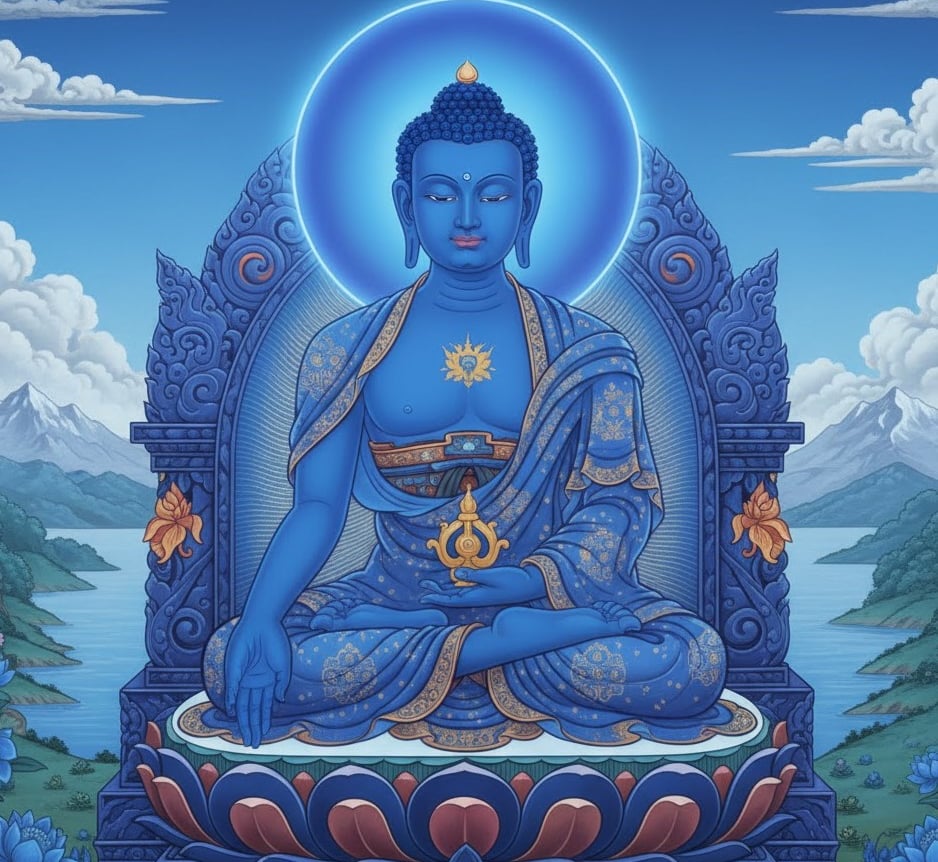
Iconographically, Akshobhya is rich in symbolism, with every detail pointing to his core teaching. He is invariably depicted as the deep blue Buddha, a color that symbolizes the vastness, purity, and imperturbable nature of space and the ocean, reflecting the boundless clarity of his wisdom. His body is typically shown seated in the full lotus position (vajraparyankasana), representing perfect stability and meditation. His right hand rests upon his knee and touches the earth, palm inward, in the Earth-Touching Mudra (Bhumisparśa Mudra) . This is the same gesture the historical Buddha, Siddhartha Gautama, made at the moment of his enlightenment, calling the Earth to witness his realization and his triumph over the demon Mara and the forces of delusion. In Akshobhya’s context, this mudra powerfully symbolizes his unwavering, immovable commitment to his vow and his victory over the agitation of hatred. His left hand rests on his lap in the Meditation Mudra (Dhyana Mudra), often holding his distinguishing emblem: the Vajra, or thunderbolt. The Vajra is the ultimate symbol of the indestructible nature of absolute reality and the fierce, diamond-like quality of the enlightened mind that can cut through any delusion. It represents the adamantine, unbreakable commitment of his spiritual path.
Akshobhya is prominently associated with the East direction, which aligns with the rising sun, symbolizing the start of the path and the dawn of wisdom. He is the head of the Vajra Family (Vajrakula), a group of deities, bodhisattvas, and practices focused on utilizing method and skillful means to achieve enlightenment, emphasizing the fierce, piercing power of wisdom. The esoteric identification of Akshobhya within the five aggregates of existence (skandhas) is with Form (Rupa), the material aspect of reality. By transforming the attachment and grasping associated with the material world (which can often lead to greed and anger), Akshobhya reveals the purity inherent in form itself. Furthermore, he is linked to the element of Water or Ether/Space, depending on the tradition, both of which possess an unshakeable quality: water's ability to flow and conform without being destroyed, and space's capacity to contain all things without being affected. His sacred syllable, often used in mantra practice, is HŪM, a powerful and forceful sound that symbolically crushes the ego and stabilizes the mind.
The practice of Akshobhya is fundamentally a profound form of purification. Since his primary function is to transform hatred and aversion, his meditation and mantra are widely used for dissolving negative karma, especially karma accumulated through acts of anger, jealousy, or malicious intent. Practitioners who find themselves dominated by rage, chronic resentment, or deep-seated unforgiveness are often guided to Akshobhya practice as a potent antidote. By visualizing his deep blue form and reciting his mantra, such as the short form Oṃ Akṣobhya Hūṃ, the practitioner invokes his immovable clarity to counteract the fiery, destructive energy of anger. This practice is believed not only to purify past negative actions but also to install the Mirror-Like Wisdom the ability to reflect reality exactly as it is, without the distortion of personal bias, emotional reaction, or ego attachment. When the mind achieves this wisdom, it sees all beings and phenomena with equanimity, which is the direct opposite of anger and partiality.
In the Mandalas of Vajrayana Buddhism, Akshobhya occupies the central position in the Vajradhatu (Diamond Realm) Mandala, sometimes replacing the Adi-Buddha Vairochana. His placement underscores his role as the master of the Vajra family and the initiator of the transformative process. His position in the East signifies the entry point for wisdom, where the practitioner begins the path of transformation by directly confronting and transmuting the core delusion of hatred. The transformation of hatred is considered particularly challenging because of its intensity and destructiveness, making the stable power of Akshobhya essential for success. The spiritual quality he embodies the ability to remain calm and unshaken amidst chaos is critical for all stages of advanced meditation.
Beyond individual practice, Akshobhya is also revered in funerary rites and practices for the deceased, particularly within Tibetan Buddhism. It is believed that his immense power of purification can benefit beings who are suffering in lower realms or in the Bardo (intermediate state between death and rebirth) due to negative karma generated by anger. Meditating on Akshobhya or reciting his mantra during these periods is thought to invoke his unshakeable compassion to cleanse the heavy karmic imprints of hatred, guiding the consciousness toward a favorable rebirth or, ideally, liberation. This belief highlights the compassionate application of his immovability: it is an immovability for the sake of all sentient beings, a stability that enables boundless, unperturbed compassion.
In essence, Akshobhya Buddha represents the ultimate spiritual resilience. He teaches that genuine freedom comes not from trying to control the external world to prevent disturbances, but from cultivating an inner state so profoundly stable that external forces cannot shake it. He is the master alchemist who takes the poison of hatred the most destructive of the mental afflictions and transmutes it into the diamond of wisdom, a clarity that reflects all things perfectly and provides the unshakable ground for full enlightenment. His legacy inspires the practitioner to stand firm against the winds of passion and aversion, maintaining the Bodhisattva vow with the same fierce, unwavering resolve that brought him to Buddhahood in the pure land of Abhirati. To seek Akshobhya is to seek the unshakeable nature of one's own enlightened mind.
Sera Jey Wisdom Center
A Gelug Tibetan Buddhist center in Jakarta. Join our weekly prayers every Saturday at 2 PM — everyone is welcome.
Address
Sera Jey Wisdom Center
Ruko Savoy Blok C1 No.31 & 32,
River Garden Jakarta Garden City,
Cakung Timur, Jakarta Timur 13910,
Indonesia
© 2026 Sera Jey Wisdom Center Jakarta. All rights reserved.