
Devas: The Four Heavenly Kings
Explore the majestic realm of the Four Heavenly Kings, the celestial guardians of Buddhist cosmology. From the harmonizing lute of the East to the protective umbrella of the North, discover how these four powerful Devas safeguard the Dharma and inspire a life of mindfulness, virtue, and spiritual vigilance.
Devas: The Four Heavenly Kings
The concept of the Four Heavenly Kings, known as Caturmahārāja in Sanskrit or Devas in a broader celestial context, represents one of the most foundational elements of Buddhist cosmology and protection.
These four majestic figures are not merely mythological entities but are considered the primary guardians of the world and the protectors of the Dharma, residing in the Cātummahārājika heaven on the lower slopes of Mount Meru. According to ancient texts, they serve as the direct subordinates of Shakra, the ruler of the Trāyastriṃśa heaven, and are tasked with monitoring the activities of humanity to report back on the prevalence of virtue and righteousness on Earth. Each king is assigned to a specific cardinal direction, governing a unique class of supernatural beings and wielding symbolic weapons that reflect their specific roles in maintaining cosmic order and spiritual safety. Their presence is a staple in Buddhist temples across Asia, where they often stand at the entrance gates to ward off evil spirits and remind practitioners of the vigilance required on the path to enlightenment.
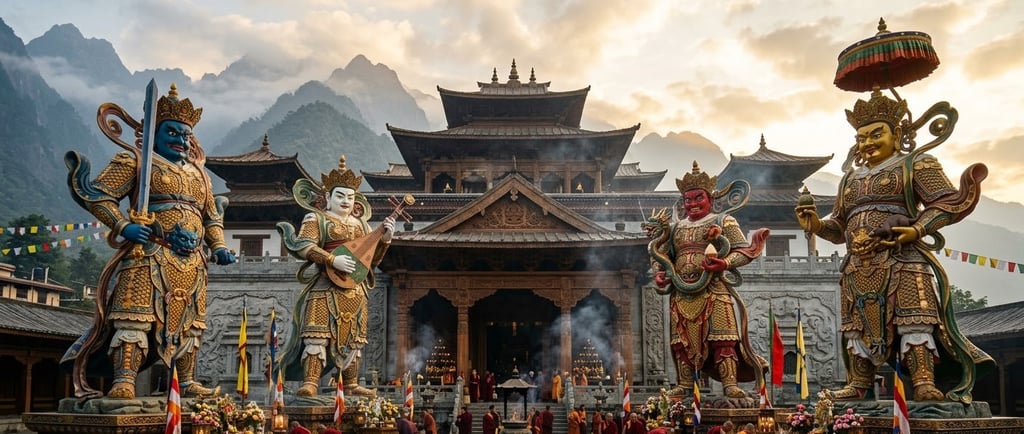
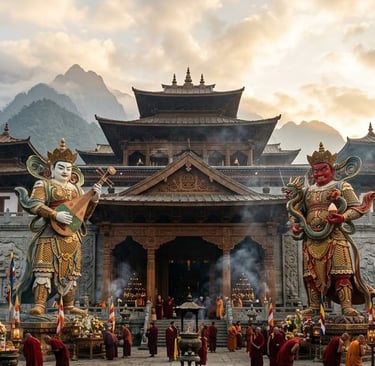
Dhṛtarāṣṭra, the Heavenly King of the East, is the protector of the kingdom and the leader of the Gandharvas, who are celestial musicians and spirits of the air. He is typically depicted with a white complexion, embodying harmony, purity, and the sustaining power of music. Unlike his counterparts who carry aggressive weaponry, Dhṛtarāṣṭra is often shown holding a pipa, a traditional lute, which symbolizes his method of governing through melody and the balance of sound. This musical instrument serves as a metaphor for the Middle Way in Buddhism; if the strings are too tight, they snap, and if they are too loose, they will not play. Through the harmony of his music, he converts sentient beings to the path of peace and ensures that the eastern quarter of the universe remains stable. His role emphasizes that protection and influence are not always achieved through force, but through the cultivation of inner harmony and the resonance of virtuous conduct.
In the South stands Virūḍhaka, the Heavenly King who causes the roots of virtue to grow. He is the lord of the Kumbhandas, a group of powerful spirits associated with the energy of growth and vitality. Usually portrayed with a blue or green countenance, Virūḍhaka wields a mighty sword that represents his ability to cut through ignorance and foster spiritual development. His name literally translates to "one who enlarges" or "the patron of growth," highlighting his function as a catalyst for the expansion of the Dharma. The sword he carries is not an instrument of senseless violence but a tool of wisdom used to sever the ties of earthly desires and delusions that prevent a practitioner from progressing. By guarding the southern realm, he ensures that the seeds of merit planted by sentient beings are protected from the withering effects of negativity and spiritual decay.
Moving to the West, we find Virūpākṣa, the Heavenly King of the Western Direction and the leader of the Nagas, or serpent-beings. He is often recognized by his red complexion and his piercing eyes, which give him the name "the wide-eyed one" or "one who sees all." Virūpākṣa is the celestial observer who watches over the world with a discerning gaze, identifying both the suffering of beings and the hidden dangers that threaten the balance of the universe. He is frequently depicted holding a jewel or a small stupa in one hand and a serpent or a cord in the other. The serpent represents the control over the passions and the subduing of malicious forces, while the jewel symbolizes the precious nature of the Buddha’s teachings. His role as a guardian involves the constant surveillance of the world, ensuring that no shadow remains hidden and that the light of truth reaches even the most remote corners of the western realm.
Vaiśravaṇa, also known as Kubera in some contexts, is the Heavenly King of the North and is arguably the most prominent and widely worshipped of the four. As the leader of the Yakshas, he is the primary protector of the Buddha's teachings and a symbol of immense wealth and prosperity. Often depicted with a golden or yellow complexion, Vaiśravaṇa is shown in full armor, holding a decorative umbrella or parasol in one hand and a mongoose that spits jewels in the other. The umbrella signifies his role as a shield, protecting the world from the "rains" of misfortune and spiritual obstacles, while the mongoose represents his command over material and spiritual abundance. Because he is said to have heard many of the Buddha's discourses directly, he is also associated with great learning and the preservation of sacred knowledge. His northern guardianship is seen as the final line of defense against the forces of chaos, standing firm as a pillar of strength and generosity.
The collective significance of these Four Heavenly Kings extends beyond their individual attributes, as they represent the four seasons and the total protection of the space-time continuum. In traditional temple architecture, they are placed in the Hall of the Heavenly Kings, acting as a spiritual "customs house" where visitors must pass through before entering the main shrine. This placement is symbolic of the transition from the mundane world into the sacred space of the Buddha. By encountering these formidable guardians, the practitioner is reminded to leave behind worldly distractions and to adopt a state of mindfulness. The Kings serve as reminders that the universe is governed by moral laws and that one’s actions are constantly being observed by the celestial realm. Their role is to provide the security and stability necessary for practitioners to focus entirely on their spiritual cultivation without fear of external interference.
In the context of the Cātummahārājika heaven, these devas live lives of immense duration and splendor compared to human standards, yet they remain subject to the laws of karma and rebirth. This is a crucial distinction in Buddhist thought; despite their great power and divine status, they are not immortal gods but advanced beings who have attained their positions through the accumulation of vast merit. They are viewed as fellow travelers on the path, albeit much further along, who have taken a vow to serve the Buddha and protect those who follow his teachings. Their relationship with humanity is reciprocal; while they provide protection and inspiration, humans offer them merit through virtuous deeds and rituals. This interaction reinforces the Buddhist idea of an interconnected universe where the celestial and terrestrial realms are bound together by the pursuit of enlightenment.
The iconography of the Four Heavenly Kings has evolved significantly as Buddhism spread from India into China, Korea, Japan, and Southeast Asia. In the Chinese tradition, they became associated with the four elements and the desire for favorable weather for agriculture, reflecting the needs of the societies they protected. In Japan, they are known as the Shidaitennō and are often portrayed with fierce, localized artistic styles that emphasize their martial prowess. Regardless of the stylistic variations, the core symbolism remains consistent: they are the defenders of truth and the vanquishers of delusion. Each attribute, from the pipa of the East to the umbrella of the North, serves as a visual shorthand for the various ways the Dharma is preserved and disseminated across the world.
To understand the Devas and the Four Heavenly Kings is to appreciate the layer of psychological and spiritual protection they provide to the Buddhist community. They represent the externalization of the internal discipline required to maintain a spiritual practice. Just as the Kings guard the four corners of the world, the practitioner must guard the "gates" of their own senses to prevent the entry of unwholesome thoughts and desires. The Kings are the cosmic manifestations of mindfulness, vigilance, and the active defense of one's own peace. When a devotee bows to these figures, they are not just showing respect to celestial royalty, but are reaffirming their own commitment to protecting the values of compassion, wisdom, and moral integrity in their daily lives.
Ultimately, the Four Heavenly Kings stand as timeless symbols of the balance between power and virtue. They demonstrate that true strength is found in service to a higher purpose—the protection of the Dharma and the welfare of all sentient beings. Their stories and images continue to inspire millions, offering a sense of divine companionship and the assurance that the path to enlightenment is guarded by forces that value the growth of every individual's spiritual potential. In the vast architecture of Buddhist thought, they remain the steadfast sentinels of the world, ensuring that as long as there is a sincere heart seeking truth, there will be a guardian there to protect it.
Sera Jey Wisdom Center
A Gelug Tibetan Buddhist center in Jakarta. Join our weekly prayers every Saturday at 2 PM — everyone is welcome.
Address
Sera Jey Wisdom Center
Ruko Savoy Blok C1 No.31 & 32,
River Garden Jakarta Garden City,
Cakung Timur, Jakarta Timur 13910,
Indonesia
© 2026 Sera Jey Wisdom Center Jakarta. All rights reserved.