Chakrasamvara
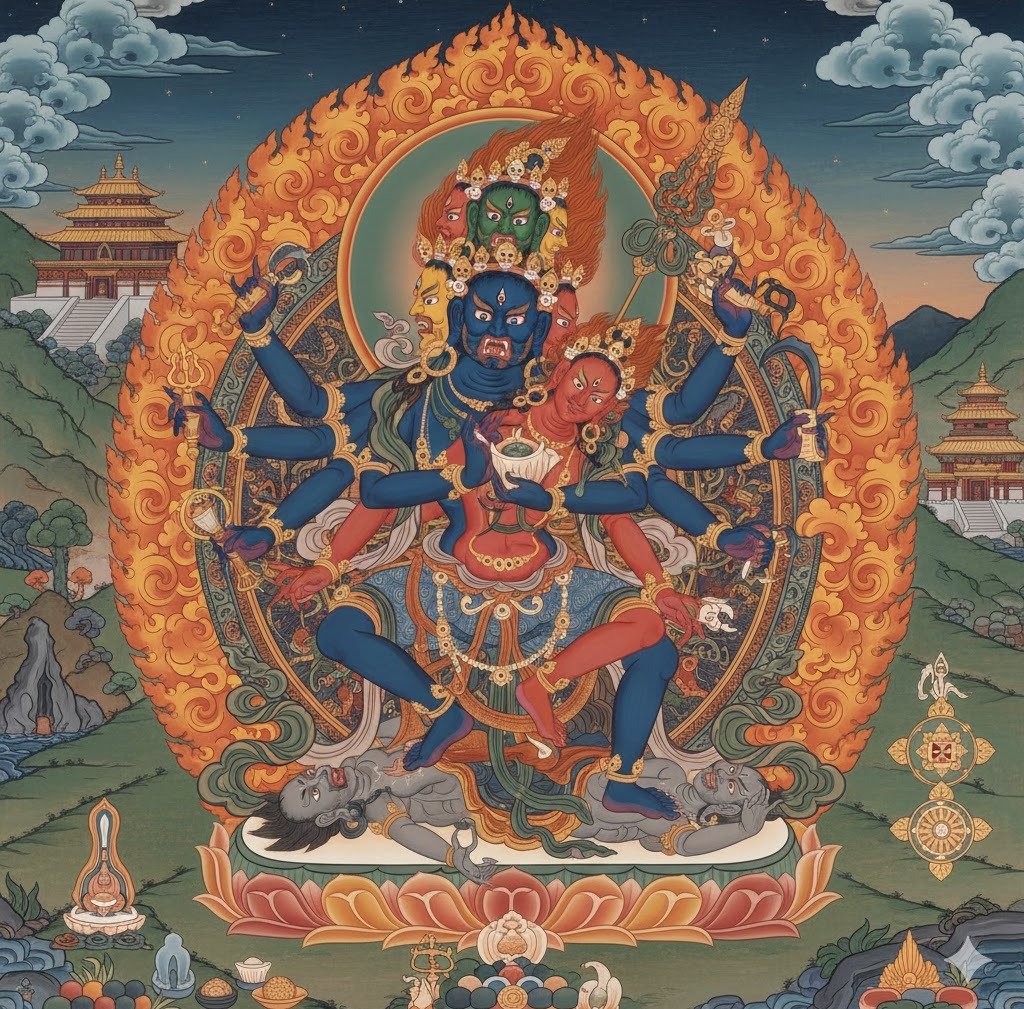
Chakrasamvara (Wheel of Perfect Bliss) is the principal meditational deity (Yidam) of the Anuttarayoga Tantra, the highest class of Buddhist tantric practice, revered across the Gelug, Kagyu, and Sakya schools. This fierce, twelve-armed Heruka embodies the ultimate realization of Great Bliss (maha-sukha) and the Wisdom of Emptiness (shunyata) in indivisible union. His embrace with his consort, Vajrayogini (Yab-Yum), symbolizes this non-dual truth—the fusion of skillful means and wisdom.
Chakrasamvara, whose name means "Wheel of Perfect Bliss" or "Supreme Bliss-Wheel," stands as one of the most prominent and fiercely protective Yidam (meditational deities) within the pantheon of Tibetan Vajrayana Buddhism, particularly revered across the Gelug, Kagyu, and Sakya schools.
His profound significance lies in his role as the principal deity of the Anuttarayoga Tantra, the highest class of Buddhist tantras, representing the core methods for rapidly achieving enlightenment through the transformation of ordinary experience. He is the personification of the union of great bliss (maha-sukha) and the wisdom of emptiness (shunyata), a central philosophical and experiential tenet of the Vajrayana path. The visualization and practice associated with Chakrasamvara are designed to overcome all dualistic conceptions, transforming the practitioner's body, speech, and mind into the deity's awakened qualities.
The origin of the Chakrasamvara tradition is rooted in the Indian Mahasiddha tradition, reaching its peak in the eastern regions of Bengal and Orissa between the 8th and 12th centuries C.E. The foundational text is the Shri Chakrasamvara Tantra, sometimes referred to as the Laghu-Samvara or Abhidhana-uttara Tantra. This text, along with its extensive commentaries, details the complex mandalas, rituals, and meditative practices of the tradition. The practice was carried from India to Tibet by legendary figures like the great translator Rinchen Zangpo and the Indian master Naropa, whose lineage forms the basis of the Kagyu school's core practices. The importance of the Chakrasamvara system cannot be overstated; for many practitioners, particularly those in the Kagyu tradition, it is considered the primary Yidam, the ultimate key to unlocking the true nature of reality.
Chakrasamvara is typically depicted in his Heruka form: fierce, dark blue in color, standing in a dynamic posture upon the prostrate forms of the Hindu deities Kalaratri (Time) and Bhairava (Terror), symbolizing the conquest of attachment and anger, and the transcendence of conventional concepts of time and ego. He is shown with four faces, representing the four cardinal directions and the four doors of liberation, and twelve arms, symbolizing the twelve links of dependent origination that he cuts through to achieve enlightenment. Each hand holds a significant implement, such as the vajra (thunderbolt), the bell, the khatvanga (ritual staff), and a skull-cup filled with blood, all serving as metaphors for advanced tantric realizations and the destruction of ignorance. The most significant aspect of his iconography is the embrace of his consort, Vajrayogini (or sometimes Vajravarahi).
The profound union of Chakrasamvara and Vajrayogini, known as Yab-Yum (Father-Mother), is the ultimate visual metaphor in the practice. It is not an image of worldly passion, but a sophisticated symbol of the non-dual truth: the father, Chakrasamvara, embodies skillful means (upaya), the active, compassionate engagement with the world which is inextricably linked with the mother, Vajrayogini, who embodies wisdom (prajna or shunyata), the realization of the empty nature of all phenomena. The ecstatic union represents the indivisible co-emergence of compassion and emptiness, the very essence of Buddhahood. The practitioner engages in the visualization of this union to experientially realize the fusion of these two qualities within their own mindstream, thereby purifying the energy centers (chakras) of the body.
The practice centers on the purification of the Chakras, which are the energy centers of the subtle body. The Chakrasamvara Tantra is named such because the deity is visualized as being seated at the center of a cosmic mandala, which is simultaneously visualized as the practitioner's own body. The tradition asserts that enlightenment can only be realized when the six main chakras, Crown, Forehead, Throat, Heart, Navel, and Secret—are purified of the karmic obscurations that block the flow of the vital energies (prana or lung). The visualization and mantra recitation work to harness the powerful energy flows, guiding them into the central channel, where the conventional mind is dissolved, giving rise to primordial, innate wisdom.
The lineage transmission of the Chakrasamvara practice is a delicate and sacred process requiring initiation (abhisheka) from a qualified guru. Without this transmission, the complex visualization and ritual practices are considered ineffectual and potentially dangerous. The practice is typically divided into two main stages: the Generation Stage and the Completion Stage.
Generation Stage (Kyerim): In this stage, the practitioner dissolves their ordinary self-image and visualizes themselves arising as the deity Chakrasamvara in his complete form, including the entire mandala, the consort, and the surrounding retinue. This is a practice of profound imagination and concentration, which aims to purify the practitioner's attachment to the mundane body and mind by recognizing the body as the pure embodiment of the deity and the environment as the pure land (mandala). This stage uses the three purifications purifying body, speech, and mind and the three recognitions recognizing the form as the deity, sound as mantra, and thoughts as wisdom.
Completion Stage (Dzogrim): This stage is more subtle and experiential, focusing on the manipulation of the internal wind-energies (lung), channels (tsa), and essences (tigle) of the subtle body. The practitioner employs techniques like Tumo (inner heat yoga) to melt the inner energies, driving them into the central channel. This action causes the four blisses to arise, which are then used as a support to realize the clear light nature of the mind, the ultimate experience of wisdom and emptiness. This stage is highly esoteric and is the actual, direct cause for attaining the Vajra-Kaya, the supreme, indestructible body of a Buddha.
The Chakrasamvara Tantra is taught alongside the Guhyasamaja and Yamantaka Tantras as the core of their highest practices. The lineage masters of the Gelug school, including the Dalai Lamas, rely on the detailed commentaries for an intellectual and experiential mastery of the two stages. Similarly, in the Kagyu school, the practice forms the central Yidam of the four major and eight minor sub-schools, passed down through the famed lineage of the 84 Mahasiddhas. The commitment to the daily practice of the sadhana (ritual text) of Chakrasamvara is a defining characteristic of a serious Vajrayana practitioner in these traditions, often continuing throughout their entire lives.
In essence, Chakrasamvara is not merely a figure to be worshipped, but a complex, multi-layered meditational tool that embodies the entire Buddhist path to enlightenment. He represents the possibility of transforming the most powerful human afflictions, the three poisons of desire, hatred, and ignorance into the pure, radiant energy of compassion and wisdom. The violent and sexual imagery serves as a powerful reminder that the path to liberation is achieved not by avoiding the energies of life, but by confronting and transforming them through the wisdom of non-dual realization. The very act of visualizing the Wheel of Perfect Bliss at the center of one's being is the commitment to live out the indivisible union of wisdom and compassion in every moment.
Sera Jey Wisdom Center
A Gelug Tibetan Buddhist center in Jakarta. Join our weekly prayers every Saturday at 2 PM — everyone is welcome.
Address
Sera Jey Wisdom Center
Ruko Savoy Blok C1 No.31 & 32,
River Garden Jakarta Garden City,
Cakung Timur, Jakarta Timur 13910,
Indonesia
© 2026 Sera Jey Wisdom Center Jakarta. All rights reserved.