Buddhist Deity Hayagriva
Discover the fierce yet compassionate Buddhist deity Hayagriva, a horse-headed manifestation of Avalokiteshvara, whose powerful roar vanquishes obstacles and ignorance to guide practitioners toward enlightenment.
The fierce and formidable deity Hayagriva stands as one of the most compelling and powerful figures within the vast pantheon of Vajrayana Buddhism, a wrathful emanation of the Buddha of Compassion, Avalokiteshvara.
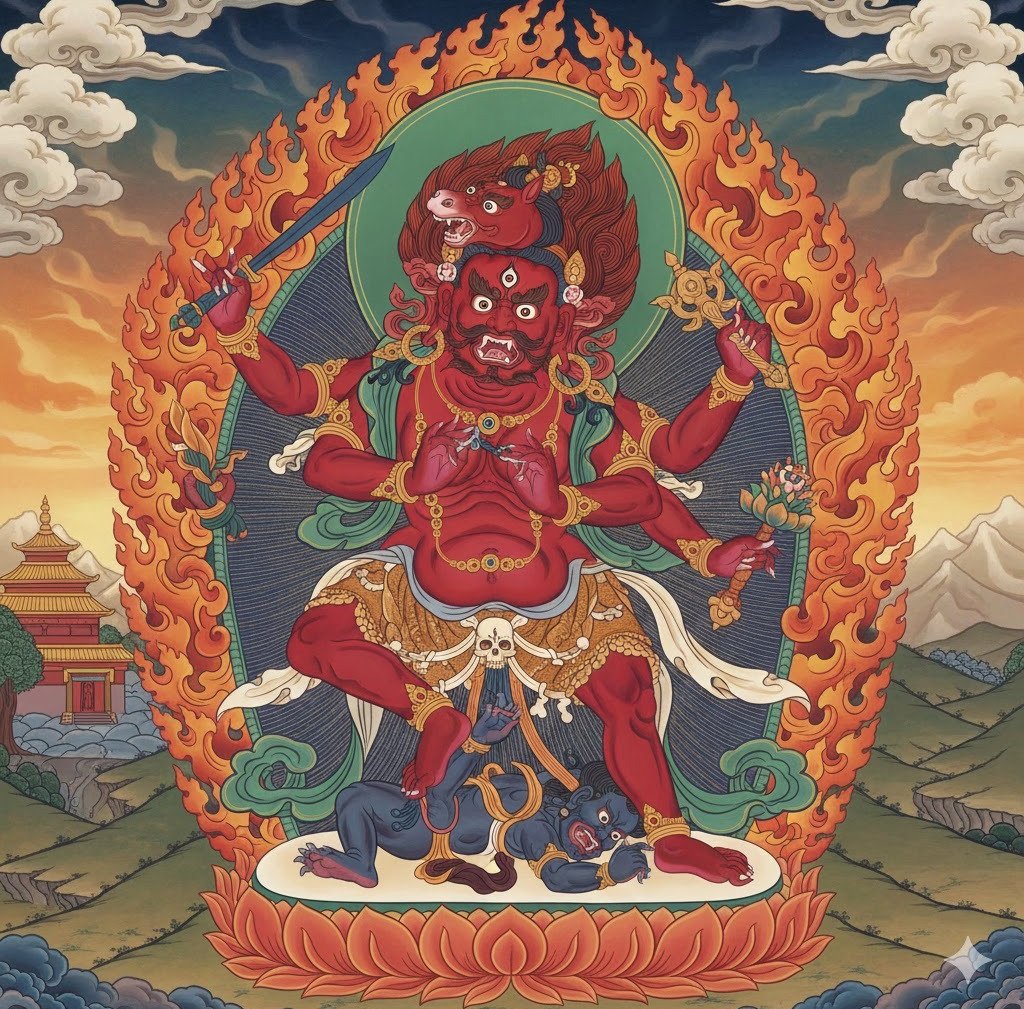
His very name, deriving from Sanskrit, means "horse-necked," a defining characteristic that immediately sets him apart and holds profound symbolic significance. Often depicted with a terrifying red body, multiple heads, arms, and legs, crowned by one or more green horse heads emerging from his flaming hair, Hayagriva is not a force of destruction in the conventional sense, but rather a manifestation of enlightened fury aimed at eradicating ignorance, delusion, and the inner and outer obstacles that hinder spiritual progress. This wrathful appearance is a skillful means, a compassionate expression designed to shock practitioners out of their complacency and confront the most deeply ingrained defilements. His ferocious visage, baring fangs, with bulging eyes and a thunderous roar, is understood not as malevolence but as an intense, unyielding determination to liberate all sentient beings from suffering.
The origins of Hayagriva are deeply intertwined with ancient Indian mythology and the evolution of Buddhist thought. While some scholars trace aspects of his iconography to earlier Hindu deities, his full development as a distinct Buddhist Yidam, or meditational deity, is firmly rooted in the tantric traditions that flourished in India and later spread to Tibet. He is particularly prominent in the Nyingma, Sakya, and Gelug schools of Tibetan Buddhism, where his practice is highly revered for its efficacy in overcoming obstacles, curing diseases, and subjugating negative forces. The textual basis for Hayagriva’s practice can be found in various tantras, including the Hayagriva Tantra and the Padma-Tantra, which detail his forms, mantras, and the elaborate rituals associated with his invocation. These texts describe his ability to swift action and his particular prowess in protecting the dharma from destructive influences, both mundane and spiritual. His connection to Avalokiteshvara underscores his fundamentally compassionate nature; despite his terrifying exterior, his ultimate aim is always the benefit and enlightenment of all beings, acting with the speed and power of a wild horse to achieve these ends.
One of Hayagriva’s most striking features is the horse head (or heads) emerging from his hair, often depicted in a vibrant green color. This attribute is not merely decorative; it carries rich symbolic meaning. The horse, particularly in Asian cultures, is a symbol of untamed power, swiftness, and unwavering determination. It represents an unbridled energy that, when harnessed, can overcome immense distances and obstacles. In Hayagriva's context, the horse's neigh is said to shatter all delusion and the fundamental ignorance that binds beings to cyclic existence. It is a powerful roar that cuts through misconceptions and awakens beings to the true nature of reality. Furthermore, the horse head is sometimes associated with the wisdom aspect of the deity, indicating that his fierce activity is always guided by profound insight into emptiness. The green color of the horse head can also symbolize karma-family activity, representing the swift and skillful accomplishment of all enlightened actions. This unique iconographic detail serves as a constant reminder that Hayagriva’s ferocity is not mindless but a highly focused, skillful, and compassionate energy directed towards the highest spiritual goal.
The practice of Hayagriva is particularly cherished for its ability to overcome various forms of obstacles, both external and internal. Externally, practitioners invoke Hayagriva to dispel harmful spirits, counteract black magic, cure illnesses, and protect against dangers. His fierce energy is believed to purify environments and remove the energetic blockages that prevent well-being. Internally, and perhaps more importantly, Hayagriva’s practice is a potent tool for confronting and transforming negative emotions such as anger, hatred, attachment, and ignorance. By meditating on Hayagriva, practitioners are encouraged to recognize these destructive emotions not as inherent flaws, but as transient mental states that can be purified and transformed into wisdom. The wrathful aspect of Hayagriva serves as a mirror, reflecting the practitioner's own latent capacity for fierce, decisive action in overcoming inner demons. His practice is thus a dynamic process of self-transformation, where one engages with intense energy to break free from psychological and emotional bondage.
Iconographically, Hayagriva is typically portrayed standing in a powerful, dynamic posture, often upon a lotus throne, symbolizing his purity, and trampling upon various demons or naga figures, representing the subjugation of negative forces and worldly attachments. His body is usually a brilliant red, symbolizing his active compassion and the transformative power of wrath. He often has three faces, each with a wrathful expression, symbolizing his mastery over the three poisons desire, hatred, and ignorance and his ability to benefit beings in the past, present, and future. His multiple arms hold various implements, each with its own symbolic significance. These commonly include a vajra (thunderbolt), representing unbreakable wisdom and skillful means; a sword, cutting through ignorance; a lasso, binding negative forces; a skull cup filled with blood or nectar, symbolizing the ultimate bliss of enlightenment; and a lotus, representing purity and compassion. His flaming halo signifies the burning away of all obscurations and the radiant light of wisdom. The presence of a third eye on his forehead indicates his transcendent wisdom and clairvoyant abilities, allowing him to perceive all realities without distortion.
The mantra of Hayagriva, particularly the short form "Om Hrih Padma Haya Griva Hum Phat," is central to his practice. The recitation of this mantra is believed to invoke his powerful energy and blessings, purifying negative karma and creating conducive conditions for spiritual realization. "Om" represents the sacred sound of the universe, "Hrih" is a seed syllable associated with compassion and the heart, "Padma" refers to the lotus family, emphasizing his connection to Avalokiteshvara, and "Haya Griva" is his name. "Hum" signifies the adamantine mind of enlightenment, and "Phat" denotes the cutting through of obstacles. Through repeated recitation and visualization, practitioners aim to absorb Hayagriva’s enlightened qualities, transforming their own minds and developing the courage, wisdom, and compassion necessary for the path to awakening. The visualization aspect of his practice involves seeing oneself as Hayagriva, thereby integrating his powerful qualities into one's own being and understanding that the wrathful deity is not separate from one's own enlightened nature.
In conclusion, Hayagriva is far more than just a fierce image; he is a profound symbol of compassion in action, a wrathful deity whose terrifying appearance serves as a potent antidote to ignorance and suffering. His horse head embodies swift and decisive wisdom, his red body signifies active compassion, and his various implements represent the skillful means by which he liberates beings from cyclic existence. For practitioners of Vajrayana Buddhism, Hayagriva offers a powerful path to overcome inner and outer obstacles, to purify defilements, and to awaken to their own inherent enlightened nature. His practice is a testament to the diverse and skillful methods employed in Buddhism to guide all sentient beings towards the ultimate goal of liberation and perfect Buddhahood, transforming fear into wisdom and obstacles into opportunities for profound spiritual growth.
Sera Jey Wisdom Center
A Gelug Tibetan Buddhist center in Jakarta. Join our weekly prayers every Saturday at 2 PM — everyone is welcome.
Address
Sera Jey Wisdom Center
Ruko Savoy Blok C1 No.31 & 32,
River Garden Jakarta Garden City,
Cakung Timur, Jakarta Timur 13910,
Indonesia
© 2026 Sera Jey Wisdom Center Jakarta. All rights reserved.