

Amoghasiddhi: The Buddha of Infallible Action and the Transformation of Envy
Dive into the Northern quadrant of the Buddhist mandala with Amoghasiddhi. We explore how the Buddha of Green Light and the Abhaya Mudra helps practitioners convert inner envy into external, tireless, and spontaneous benefit for all beings.
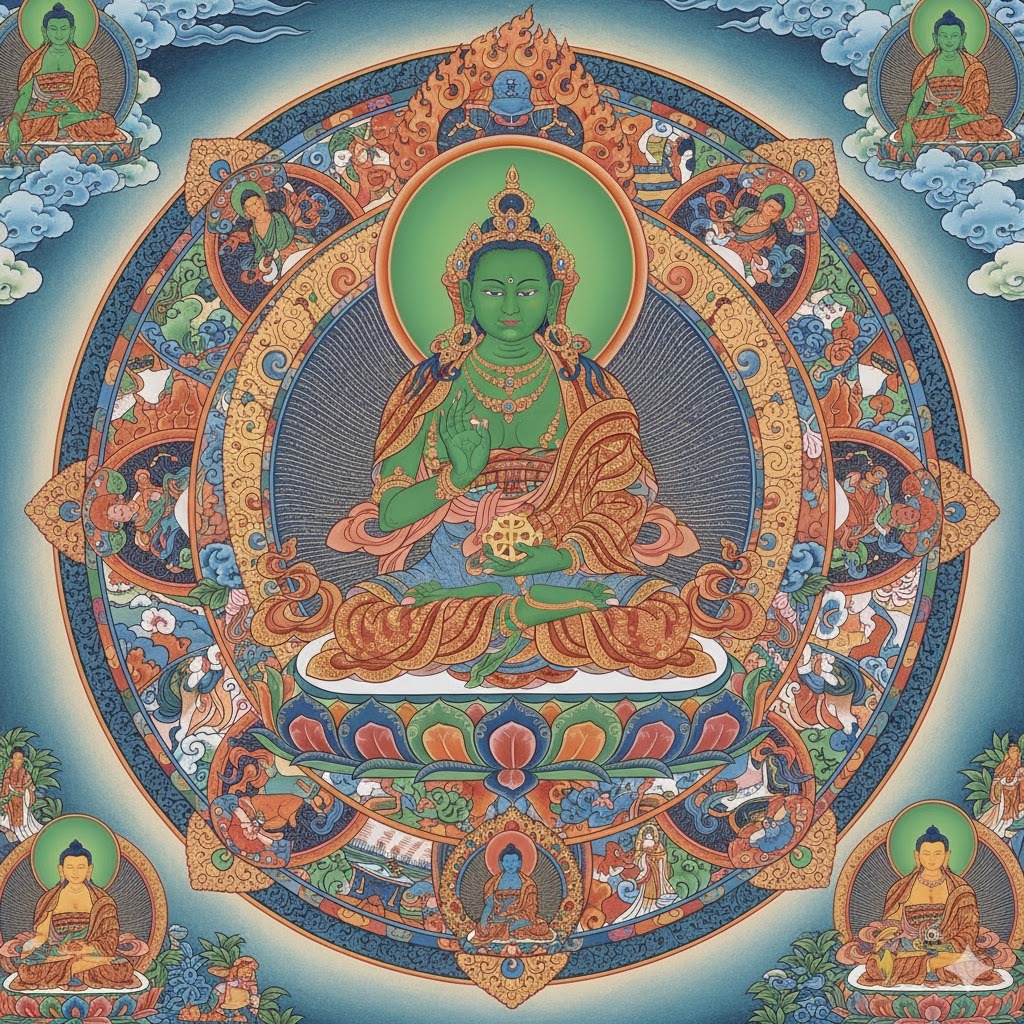
Amoghasiddhi, whose name translates to "Infallible Success" or "Unobstructed Achievement," stands as the supreme archetype of enlightened activity within the Vajrayana mandala of the Five Dhyani Buddhas. Positioned in the Northern direction, Amoghasiddhi is the embodiment of the All-Accomplishing Wisdom (Kṛtyānuṣṭhāna-jñāna), representing the perfection of compassionate action that never fails to benefit beings. He is the culminating wisdom, the energy that takes the profound insights of the other four Buddhas and manifests them skillfully in the world. His practice is essential for those seeking to overcome the subtle yet debilitating mental defilement of Jealousy and Envy (Irṣyā), transforming this corrosive emotion into pure, selfless dynamism.
Amoghasiddhi is traditionally depicted with the color Green, which symbolizes activity, vitality, and renewal—the vibrant energy of life and the Earth's continuous growth. This color speaks to his role as the master of practical application and manifestation. The Green Buddha is associated with the element of Air or Wind, which is characterized by movement, permeation, and ubiquity. Just as the wind touches everything, his compassionate activity is pervasive, ceaseless, and non-selective, reaching every corner of existence to aid sentient beings. His consort, Tārā (often Green Tārā), perfectly mirrors this active compassion, famed for her immediate response to the pleas of those in distress, thus symbolizing the speed and efficacy of Amoghasiddhi's wisdom. This dynamic pairing of the Buddha and his Prajña (wisdom partner) underscores the Vajrayana principle that wisdom (feminine) and method (masculine) must be fully unified for enlightenment to manifest as active benefit.
The key mudra, or hand gesture, of Amoghasiddhi is the Abhaya Mudra (Gesture of Fearlessness or Protection). In this gesture, his right hand is raised to shoulder height, palm facing outward, fingers extended upwards. This powerful position instantly conveys a sense of assurance, refuge, and protection from all dangers, both external and internal. By offering this fearless embrace, Amoghasiddhi directly counters the anxiety, insecurity, and fear that often lie at the root of envy. The Abhaya Mudra is a declaration of confidence in the enlightened path and a pledge that all efforts made with pure intention will lead to success and safety. The left hand, resting in his lap, typically holds a Viśvavajra (Double Vajra or Crossed Vajra), which is his distinguishing emblem. This unique symbol represents the perfect harmony and stability of the four enlightened activities and the union of all four cardinal directions, signifying absolute, unshakable foundation and universal reach.
The purification of Jealousy and Envy is central to Amoghasiddhi's transformative power. Envy is the painful and grasping state of mind that focuses on the attainments, happiness, or qualities of others, wishing for them to be diminished or resentful of one's own lack. This defilement is profoundly destabilizing because it turns the focus outward and generates suffering from comparison and competition. Amoghasiddhi's practice involves recognizing that this compulsive, comparing energy is, in its essence, the distorted form of the All-Accomplishing Wisdom. When envy is released from its grasping and comparison, its innate energy is freed to become pure, tireless, and spontaneous activity dedicated solely to benefiting others without any need for personal recognition or rivalry. Instead of begrudging another's success, one gains the enlightened ability to effortlessly bring about the success of all, including oneself.
In the context of the Five Skandhas, or aggregates of existence, Amoghasiddhi is associated with the Skandha of Volition or Compositional Factors (Saṁskāra). This aggregate encompasses all mental impulses, tendencies, and habitual formations—the driving forces behind our actions. In its unenlightened state, saṁskāra is the mechanism that perpetuates karmic actions driven by grasping and reactivity, including envy. By transforming this Skandha, Amoghasiddhi perfects the energy of impulse, turning reactive habits into wise, intentional, and perfectly timed compassionate actions. His wisdom ensures that every "compositional factor" of the practitioner's mind is aligned with the goal of liberation.
The ultimate significance of Amoghasiddhi is that he completes the circle of enlightenment, moving from wisdom (Vairochana, Akshobhya), to wealth/quality (Ratnasambhava), to magnetizing power/vision (Amitabha), and finally, to dynamic, successful implementation (Amoghasiddhi). He assures the practitioner that their spiritual work—their dedication to Vairochana's insight, Akshobhya's stability, Ratnasambhava's generosity, and Amitabha's discrimination—will not be merely theoretical or passive, but will culminate in manifest, beneficial results. He is the promise of action perfected by wisdom, a constant reminder that the path to liberation is active and requires sustained, skillful engagement with the world. Through the practice associated with Amoghasiddhi, the practitioner learns to integrate their highest spiritual realization into every moment of practical, worldly life, achieving "infallible success" not in mundane ambition, but in the ultimate goal of universal compassion and enlightenment.
Sera Jey Wisdom Center
A Gelug Tibetan Buddhist center in Jakarta. Join our weekly prayers every Saturday at 2 PM — everyone is welcome.
Address
Sera Jey Wisdom Center
Ruko Savoy Blok C1 No.31 & 32,
River Garden Jakarta Garden City,
Cakung Timur, Jakarta Timur 13910,
Indonesia
© 2026 Sera Jey Wisdom Center Jakarta. All rights reserved.